Showing posts with label census. Show all posts

Thursday, October 12, 2017

Italian American Heritage Month


October is Italian American Heritage Month. This is the time to recognize the experiences and contributions of Americans of Italian heritage. Starting in 1980 the United States Congress designated October 12th through 19th as Italian American Heritage week, and it was upgraded to a month in 1989.


2016 US Census Bureau estimate of Americans with Italian ancestry in the lower 48 states.
Created by Joshua Wallace with tools from the American Fact Finder website.
The US Census Bureau estimates that there are 16,896,518 Americans of Italian ancestry as of 2016. That's about 5% of the total population. The high point of Italian immigration to the United States was in the early 20th century. A little over 3 million Italians immigrated to the US from 1900 to 1914 (Iorizzo and Mondello 285).

Timeline of Italian-American History 
Click on the links below to find library resources on each topic. 

1492-1493 - Christopher Columbus, native of Genoa, discovered the New World and began the colonization of Puerto Rico and other Caribbean islands on behalf of Spain.
The Log of Christopher Columbus by Christopher Columbus

1499-1503 - Amerigo Vespucci, native of Florence, led multiple expeditions to the Americas on behalf of Spain and Portugal. He is credited with deducing that the lands discovered by Columbus were previously unknown continents and not islands off the coast of Asia. A German mapmaker in 1507 named this new world "America" in his honor.
Amerigo and the New World by Germán Arciniegas

1524 - Giovanni Verrazzano, native of Florence, explored the east coast of North America on behalf of France.
The European Discovery of America by Samuel Eliot Morison

1678 - Henri de Tonti, native of Gaeta, explored the Mississippi River on behalf France under the command of Robert de la Salle. He spent the rest of his life in French Louisiana.
On the Discovery of the Mississippi by Thomas Falconer

1778 - Francis Vigo, native of Mondovi and fur trader living in Spanish Louisiana, supported American independence and provided money, supplies, and information to aid the cause. He became a US citizen in 1783 and spent the rest of his life in America.
The Conquest of the Illinois by George Rogers Clark

The Frieze of American History in the United States Capitol Rotunda.
By Farragutful (Own work) [CC BY-SA 3.0 (https://creativecommons.org/licenses/by-sa/3.0)], via Wikimedia Commons
1860 - Antonio Meucci, Italian immigrant living in New York, developed the first working telephone but he never obtained a patent for it. In 1876, Alexander Graham Bell patented his phone and the rest is history.
"Antonio Meucci: Telephone Pioneer" in Bulletin of Science, Technology & Society by Basilio Catania

1877 - Constantino Brumidi (known as the "Michelangelo of the United States Capitol") began work on the Frieze of American History in the Rotunda of the United States Capitol.
Art in the United States Capitol by Architect of the Capitol

1880 - Il Progresso Italo-Americano became the first Italian language daily newspaper in the United States.

1880-1924 - Escaping extreme poverty, over 4 million Italians immigrated to the US.
The Italian Emigration of our Times by Robert F. Foerster

1887 - Francis B. Spinola, from New York, was the first Italian-American to serve in the US Congress.

1891 - An angry mob attacked a jail in New Orleans and lynched 11 Italian immigrants being held there.
"The Lynching of Sicilian Immigrants in the American South, 1886-1910" in American Nineteenth Century History by Clive Webb.

Italian immigrants faced discrimination in the US. This cartoon was printed in a New Orleans' newspaper in 1888.
By No signature seen on cartoon [Public domain], via Wikimedia Commons.
1906 - Charles J. Bonaparte was first Italian American to serve on the US Cabinet.

1913 - Rudolph Valentino immigrated to the US. He became a major film star in the silent movie era.
Idols of Modernity: Movie Stars of the 1920s by Patrice Petro

1924 - National Origins Act severely limited Italian immigration to the United States.

1941 - Joe DiMaggio, New York Yankees baseball player, sets 56 game hitting streak record.
Joe DiMaggio: the Hero's Life by Richard Ben Cramer
Beyond DiMaggio: Italian Americans in Baseball by Lawrence Baldassaro

1942 - Charles Poletti, of New York, became the first Italian American governor of a US state.

1943 - Frank Sinatra began his solo singing career.
Sinatra's Century: One Hundred Notes on the Man and his World by David Lehman
The Frank Sinatra Show with Bing Crosby, Dean Martin

1945 - John Basilone became the only enlisted Marine to receive both the Medal of Honor and the Navy Cross in World War II.

1950 - John O. Pastore, of Rhode Island, became the first Italian American to serve in the US Senate.

1956 - Rocky Marciano, heavyweight boxing champion, retired undefeated.

1966 - Jack Valenti, of Texas, began his tenure as the longest serving president of the Motion Picture Association of America (MPAA), which ended in 2004.

1986 - Antonin Scalia became the first Italian American to serve on the Supreme Court.
A Matter of Interpretation: Federal Courts and the Law by Antonin Scalia & Amy Gutmann

2007 - Nancy Pelosi, of California, became the first Italian American to serve as Speaker of the House.
Speaker Nancy Pelosi and the New American Politics by Ronald M. Peters & Cindy Simon Rosenthal

President Reagan and Antonin Scalia meet in Oval Office, 1986.
By Bill Fitz-Patrick, White House Photographer - http://www.reagan.utexas.edu/archives/photographs/supreme.html, Public Domain, https://commons.wikimedia.org/w/index.php?curid=9387478

Tarleton State University's Dick Smith Library has a wealth of resources on the Italian American experience. Such as these titles:
Imagining Italians: the Clash of Romance and Race in American Perceptions, 1880-1910 by Joseph P. Cosco
Italian Americans: the History and Culture of a People by Eric Martone
The Italian Texans by University of Texas Institute of Texan Cultures at San Antonio
New Italian Migrations to the United States ed. by Laura E. Ruberto
A New Language, a New World: Italian Immigrants in the United States, 1890-1945 by Nancy C. Carnevale

If you need assistance finding resources on this, or any other topic, then please contact us at 254-968-9249 or reference@tarleton.edu.

Works Cited 
Iorizzo, Luciano J. and Salvatore Mondello. The Italian Americans. Twayne Publishers, 1980.

Tuesday, September 19, 2017

Hispanic Heritage Month


September 15th through October 15th is National Hispanic Heritage month. This is the time to recognize the contributions and experiences of Americans of Hispanic heritage. According to the National Hispanic Heritage Month website, hosted by the Library of Congress, "September 15 is significant because it is the anniversary of the independence for Latin American countries Costa Rica, El Salvador, Guatemala, Honduras and Nicaragua. In addition, Mexico and Chile celebrate their Independence days on September 16th and 18th respectively."

2010 US Census Hispanic Population by County
Percentage of Hispanic or Latino population by county in 2010 census.
By United States Census Bureau [Public domain], via Wikimedia Commons.
Hispanic Americans are a large and quickly growing segment of the US population. In 2003, Hispanics became the largest minority group in the United States. The 2010 census counted 50,477,594 Americans of Hispanic or Latino origin. That's 16.3% of the total US population and a 43% increase from the 2000 census count.

Timeline of Hispanic-American History
Click on the links below to find relevant library resources on each topic.

1493: Christopher Columbus began Spanish colonization of Puerto Rico.
1513: Juan Ponce de León led first expedition to Florida.
1528 – 1536: Alvar Núñez Cabeza de Vaca survived an ill-fated expedition and explored portions of Texas. His book was the first written account of Texas Indians.
1539 – 1542: Hernando de Soto explored Southeast US including portions of Florida, Georgia, South Carolina, North Carolina, Tennessee, Alabama, and Mississippi. The Hernando de Soto Expedition by Jerald T. Milanich. Francisco Vásquez de Coronado explored Southwest US including portions of Arizona, New Mexico, Texas, Oklahoma, and Kansas. Documents of the Coronado Expedition, 1539 – 1542 by Richard and Shirley Cushing Flint.
1565: Pedro Menéndez de Avilés established a colony at Saint Augustine, Florida.
·         America’s Ancient City: Spanish St. Augustine, 1565 – 1763 by Kathleen A. Deagan
1598: Juan de Oñate led Spanish colonization of New Mexico.
1610: Santa Fe established as capital of New Mexico.
·         Santa Fe: History of an Ancient City by David Grant Noble
1718: Spanish colonists founded San Antonio, Texas.  
·         San Antonio de Béxar: a Community on New Spain’s Northern Frontier by Jesús F. de la Teja
·         Spanish Texas, 1519 – 1821 by Donald E. Chipman
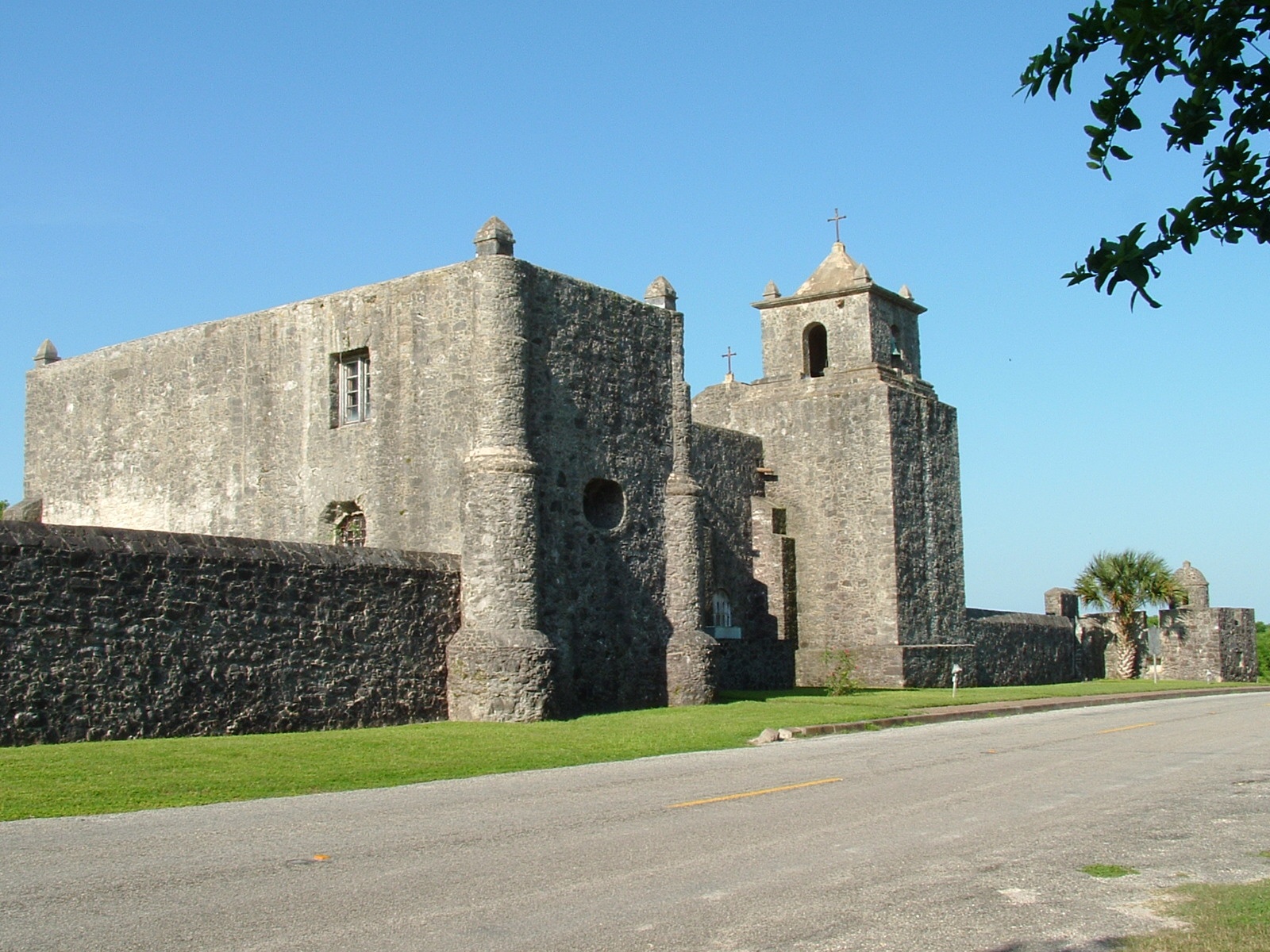
      1748 - 1755: José de Escandón led the Spanish colonization of Nuevo Santander (which today includes the Mexican state of Tamaulipas and portions of southern Texas). He established several settlements in the region including Laredo, TX. 
·            De León: a Tejano Family History by A. Carolina Castillo Crimm
    Notable Men and Women of Spanish Texas by Donald E. Chipman and Harriet Denise Joseph 
Presidio La Bahía near Goliad, TX. Originally built by the Spanish in 1721, and later rebuilt in 1771.
 Photo by Ernest Mettendorf - Public Domain, https://commons.wikimedia.org/w/index.php?curid=4208460
1769 – 1819: Spain established multiple settlements in California including San Diego (1769), San Francisco (1776), and Los Angeles (1781).
·         A History of California: the Spanish Period by Charles E. Chapman
1821: United States purchased Florida from Spain.
·         Diplomacy and the Borderlands: the Adams-Onís Treaty of 1819 by Philip Coolidge Brooks  
 Mexico won independence from Spain.
·         The Hidalgo Revolt: Prelude to Mexican Independence by Hugh M. Hamill
1822: Joseph Marion Hernández became first Hispanic to serve in the US Congress. He was a delegate from the Florida Territory.
1836: Texas declared independence from Mexico.
1845: United States annexed Texas.
·         The Annexation of Texas by Justin Harvey Smith
1848: Treaty of Guadalupe Hidalgo ended the Mexican-American War. Mexico ceded territory to US including: California, Arizona, New Mexico, Nevada, Utah, and portions of Colorado, Kansas, Oklahoma, and Wyoming. 
   The Border Crossed Us: Rhetorics of Borders, Citizenship, and Latino/a Identity by Josue David Cisneros. 
·         Border Visions: Mexican Cultures of the Southwest United States by Carlos G. Vélez-Ibañez
·         The Treaty of Guadalupe Hidalgo: a Legacy of Conflict by Richard Griswold del Castillo
1859: Juan Cortina seized control of Brownsville, TX in retaliation for town marshal’s assault on one of his employees.
·         Cortina: Defending the Mexican Name in Texas by Jerry D. Thompson
·         Juan N. Cortina: Two Interpretations by Charles William Goldfinch
1875: Romualdo Pacheco became the first Hispanic governor of a US state (California). 
1877: A white mob killed approximately 40 Mexican-Americans in Nueces County, Texas.
          Forgotten Dead: Mob Violence against Mexicans in the United States, 1848-1928 by William D. Carrigan and Clive Webb.   
1889: The Herrera brothers (Pablo, Nicanor, and Juan Jose) formed a resistance movement known as Las Gorras Blancas to protect Hispanic land from Anglo squatters in New Mexico.
1898: Spain ceded control of Puerto Rico to the United States at the conclusion of Spanish-American War.
·         Spanish-American War by Michael Golay
1910 – 1920: Revolution in Mexico resulted in increased Mexican immigration to US.
·         Pancho Villa at Columbus by Haldeen Braddy
1917: Puerto Ricans granted US citizenship.
1928: Octaviano Larrazolo, from New Mexico, became first Hispanic to serve in the US Senate.
1929: League of United Latin American Citizens (LULAC), which advocates for Latino civil rights, founded in Corpus Christi, TX.
·         LULAC, Mexican Americans, and National Policy by Craig Allen Kaplowitz
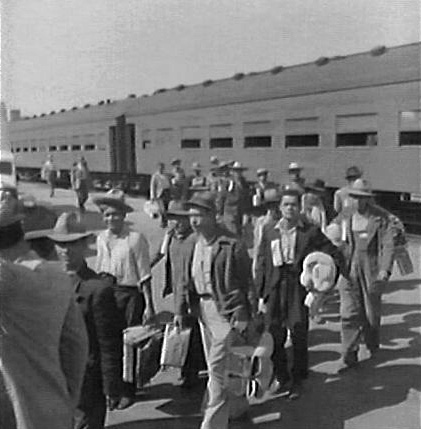
1942:  Due to labor shortage caused by World War II, US entered into an agreement with Mexico (known as the Bracero Program) to import Mexican laborers into the US.
   Harvest of Loneliness: The Bracero Program – documentary film.

The first Braceros arriving by train in Los Angeles, CA in 1942.
By Dorothea Lange, working for the US Government. [Public domain], via Wikimedia Commons. 
1943: Zoot Suit Riots in Los Angeles, CA.
·         Murder at the Sleepy Lagoon: Zoot Suits, Race, and Riot in Wartime L.A. by Eduardo Obregón Pagán
1945: Marcario García became first Mexican immigrant to be awarded the US Congressional Medal of Honor.
1948: Dr. Hector P. García founded the American G.I. Forum in Corpus Christi, TX to advocate for the civil rights of Hispanic veterans. The group gained national attention advocating on behalf of the family of Felix Longoria after a funeral home in Three Rivers, TX refused to bury him. 
1954 – 1958: US government implemented “Operation Wetback” and deported millions of people of Mexican descent.
1959: Fidel Castro’s successful revolution in Cuba resulted in increased Cuban immigration to US.
·         The Cuban Revolution: Origins, Course, and Legacy by Marifeli Pérez-Stable
1962: César Chávez and Dolores Huerta founded the United Farm Workers to advocate for the rights of migrant farm workers.
·         The Moral Vision of César Chávez by Fredrick John Dalton
·         Dolores Huerta: A Hero to Migrant Workers by Sarah E. Warren and Robert Casilla
1964: Bracero Program ended.
1965 – 1970: United Farm Workers conducted a successful strike on behalf of grape pickers in California.
·         Delano, the Story of the California Grape Strike by John Gregory Dunne
1968: Thousands of Hispanic students walkout of schools in Los Angeles, CA to protest unequal educational opportunities. Walkouts spread to hundreds of schools in multiple states.
1988: Lauro Cavazos became the first Hispanic to serve in the United States Cabinet. He served as Secretary of Education.
2003: Hispanics became largest minority group in the United States.
2009Sonia Sotomayor became the first Hispanic to serve on the Supreme Court of the United States. 
President Obama and Sonia Sotomayor meeting in the Oval Office in 2009.
By Official White House photo by Pete Souza from Washington, DC (Flickr) [Public domain], via Wikimedia Commons

The Dick Smith Library has a large collection of books and other resources on topics relevant to the Hispanic American experience. Such as these titles: 
The Mexican Americans by Alma M. García
The Spanish Americans of New Mexico: a Heritage of Pride by Nancie L. Solien Gonzalez. 

Let us know if you need assistance finding additional information by calling 254-968-9249 or emailing at reference@tarleton.edu

Tuesday, May 9, 2017

Asian/Pacific American Heritage Month

May is the month to recognize the experiences and contributions of Americans of Asian or Pacific Islander heritage. Originally established as a heritage week in 1978, it was upgraded to a month in 1990. According to the Library of Congress' Asia Pacific Heritage Month website, "May was chosen to commemorate the immigration of the first Japanese to the United States on May 7, 1843, and to mark the anniversary of the completion of the transcontinental railroad on May 10, 1869. The majority of the workers who laid the tracks were Chinese immigrants."


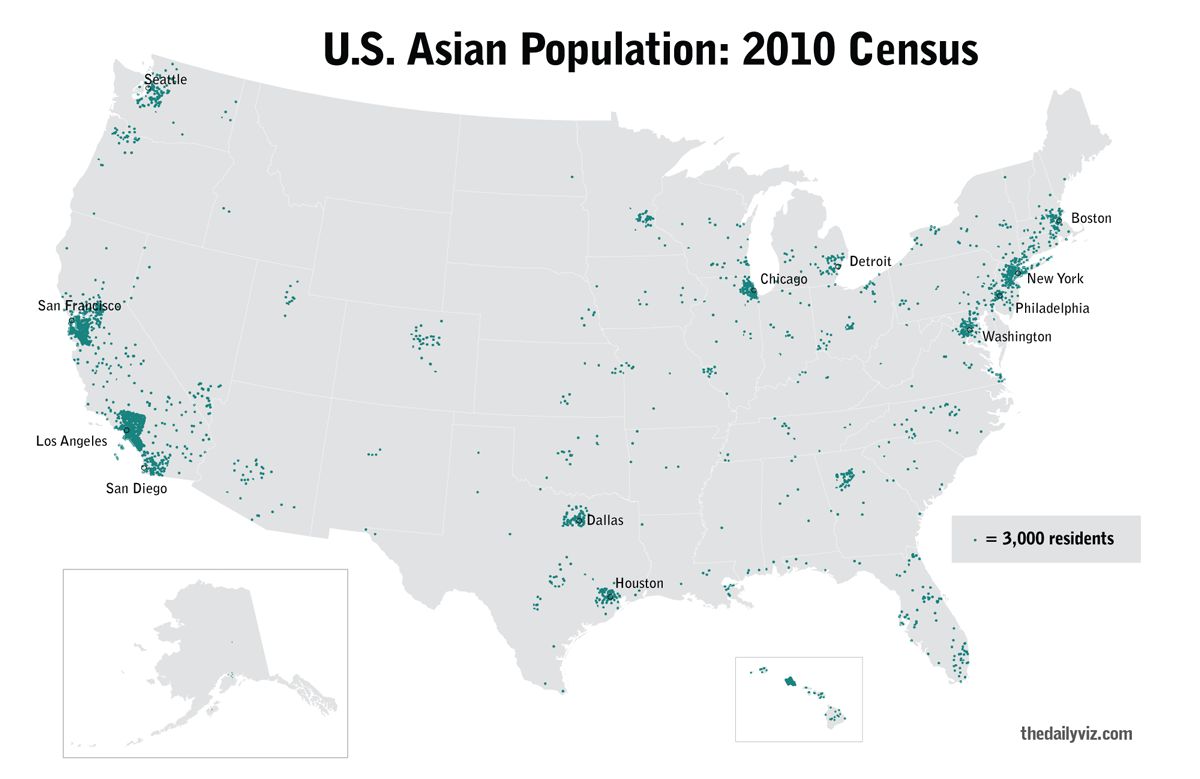
 Each green dot on the map above represents 3000 Asian Americans. By United States Census [CC BY-SA 1.0 (http://creativecommons.org/licenses/by-sa/1.0)], via Wikimedia Commons.
Asian and Pacific Islander Americans are a quickly growing segment of the population. According to the 2010 Census, there are 17,320,856 Asian Americans in the US. That is 5.6% of the total population, and is a 45.6% increase from the 2000 Census. In 2010, the Census counted 1,225,195 Americans of Hawaiian or other Pacific Islander heritage. That represents only 0.4% of the total population, however, it is a 40.1% increase from 2000.


Chronology of Asian/Pacific American History with Relevant Library Resources


1849 - California Gold Rush encouraged large numbers of Chinese to immigrate to US. 

Riches for all: the California Gold Rush and the World ed. by Kenneth N. Owens.
Gold Mountain Dreams (video available through Films on Demand database). 

1869 - Transcontinental Railroad completed, many of the workers were Chinese immigrants. 

A Great & Shining Road: the Epic Story of the Transcontinental Railroad by John Hoyt Williams

1882 - Chinese Exclusion Act severely limited Chinese immigration to the US. 

At America's GatesChinese Immigration During the Exclusion Era, 1882-1943 by Erica Lee

1885 - A mob of white miners massacred approximately 28 Chinese people in Rock Springs, Wyoming. 

"When Coal Miners Burned: The Rock Springs Massacre" in Wild West by Eric Niderost and Luc Nettleton. 

1887 - A white gang massacred over thirty Chinese gold miners along the Snake River Canyon in Oregon. 

1898 - Spain ceded control of Guam and the Philippines to the US. 

Guam and its Peoplea Study of Culture Change and Colonial Education by Laura Thompson.
A War of Frontier and Empire: the Philippine-American War, 1899-1902 by David J. Silbey           

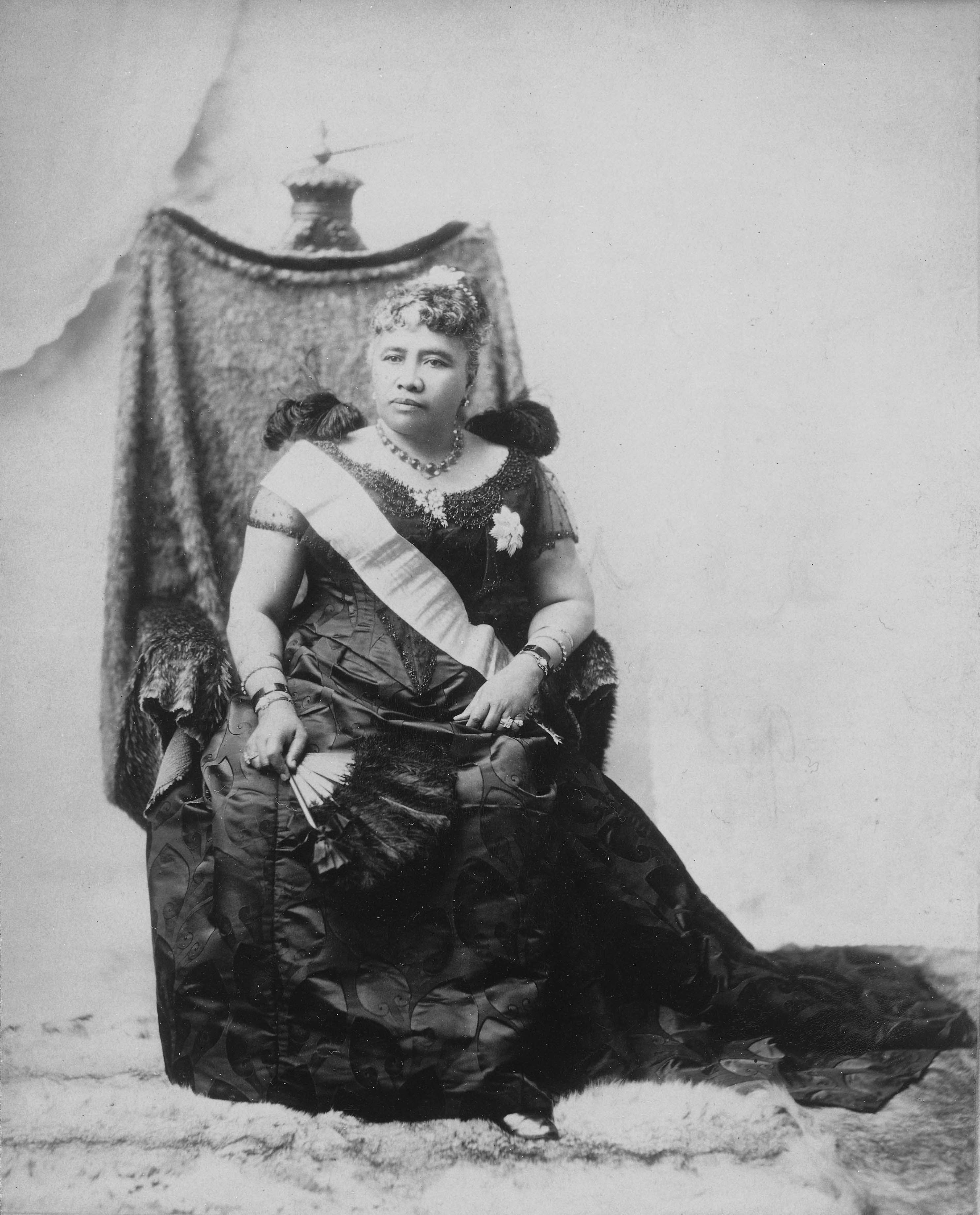
1898 - US annexed Hawaii. 

The Betrayal of Liliuokalani, last Queen of Hawaii, 1838-1917 by Helena G. Allen.

Queen Liliuokalani in 1891. James J. Williams [Public domain], via Wikimedia Commons.

1899 - US gained control of American Samoa (eastern half of the Samoan archipelago). Learn more about American Samoa here

1910 - Angel Island Immigration Station created in San Francisco Bay.  

Angel Island: gateway to Gold Mountain by Russell Freedman.
Angel Island: A Story of Chinese Immigration (video available through Films on Demand database). 

1924 - Immigration Act severely limited immigrants from most Asian countries. Read more about the Act here

1940 - Angel Island Immigration Station closed.  

1942 - President Roosevelt issued Executive Order 9066, which authorized the confinement of Japanese-Americans into internment camps. 

Looking like the enemy: My Story of Imprisonment in Japanese American Internment Camps by Mary Matsuda Gruenewald.

Arcadia, CA April, 1942. Japanese-Americans registering before being transferred to War Relocation Authority centers. By Clem Albers, Photographer (NARA record: 8452194) (U.S. National Archives and Records Administration) [Public domain], via Wikimedia Commons.

1943 - Chinese Exclusion Act was repealed. 

1944 - US gained control of Northern Mariana Islands. Learn more about the Northern Mariana Islands here

1946 - The Philippines gained independence from the US. 


1957 - Dalip Singh Saund, of California, became the first Asian American to serve in the US Congress. 

1959 - Hiram Fong, of Hawaii, became the first Asian American to serve in the US Senate. 

1965 - Immigration Act ended racial quotas, which increased immigration from Asian countries. Read more about the Act here

Korean Americans (video available through Films on Demand database).
Suburban Sahibs: Three Immigrant Families and Their Passage From India to America by Mitra S. Kalita. 

1973 - George Ariyoshi, of Hawaii, became the first Asian American governor of a US state.

1988 - Civil Liberties Act granted reparations to Japanese-Americans who had been interned during World War II. Read full text of the act here

2000 - Norman Mineta became the first Asian American to serve on the US Cabinet.

The Dick Smith Library has a large collection of resources relevant to the Asian-American and Pacific Islander-American experience. Let us know if we can help you find some information on the topic via email at reference@tarleton.edu or phone at 254-968-9249.

Thursday, April 13, 2017

The Racial Dot Map

Demographers at the University of Virginia's Weldon Cooper Center for Public Service have created an interactive map that allows users to examine population groupings throughout the United States.

The map's creators used data gathered from the 2010 census to place 308,745,538 dots on a map of the United States. Each dot represents one person counted in that census. The dots are color-coded by race/ethnicity: whites are represented with blue dots, African Americans with green dots, Hispanics with orange dots, and Asians with red dots. People who don't fall under any of the above categories are represented with brown dots.

A view of the lower 48 states.
The map allows users to zoom in to see the demographics of local areas.

A close up view of the Dallas/Fort Worth area. 

Each dot is smaller than a pixel. That makes viewing individual dots in rural areas challenging. The map allows users to turn off the racial color-coding, and every person is then represented with a black dot. This helps to better see people in rural areas.

A close up view of Stephenville, TX with color-coding removed. 
Take some time to explore this fascinating map.