November is
Native American Heritage Month. This is the time to recognize the experiences and contributions of the first Americans.
Beginning in 1986, November 23-30 was designated "American Indian Week." In 1990, it was elevated to a month long recognition. November was chosen to coincide with the end of the traditional harvest season and Thanksgiving.
 |
| Native American population by county. |
According to the
2010 Census there were 5,220,579 people of American Indian or Alaskan Native heritage residing in the US that year. That is 1.7% of the total population and a 26.7% increase since the 2000 census.
Timeline of Native American History
Click the links below to find library and online resources about each topic.
Dates listed before 1492 are estimates, and shouldn't be considered exact.
15,000 BC - Ancestors of Native Americans migrated from Asia to North America via the
Beringia land bridge during the last ice age. In recent decades archaeological and DNA research has found evidence
that:
- humans may have arrived in the Americas thousands of years before 15,000 BC,
- they may have come by boat as well as overland, and
- some may have arrived via a European route.
Many Native Americans do not
accept the
Beringia Strait Theory as most Native American tribal origin stories, passed down orally for generations, do not provide evidence for such a journey.
New Evidence for the Pleistocene Peopling of the Americas by Alan Lyle Bryan
Quest for the Origins of the First Americans by E. James Dixon
9000 BC - Beginning of the
Clovis Culture. Named from the distinctive spear points first discovered near Clovis, New Mexico in the 1930s but have since been found across North America.
Across Atlantic Ice: The Origin of America's Clovis Culture by Dennis J. Stanford
Clovis Blade Technology by Michael B. Collins
New Perspectives on the First Americans by Bradley Thomas Lepper
3500 BC - The oldest mound complex,
Watson Brake, was built near modern day Monroe, Louisiana. The
Mound Building cultures created a variety of mound complexes throughout the Midwest and Southeast United States, including eastern
Texas.
Native Americans before 1492: The Moundbuilding Centers of the Eastern Woodlands by Lynda Shaffer
Mound Builders of Ancient America by Robert Silverberg
.jpg) |
Serpent Mound in Southwest Ohio.
By Timothy A. Price and Nichole I.; uploaded by the authors. (Part of the archive Image:Serpent Mound.jpg) [GFDL (http://www.gnu.org/copyleft/fdl.html), CC-BY-SA-3.0 (http://creativecommons.org/licenses/by-sa/3.0/) or CC BY 2.5 (http://creativecommons.org/licenses/by/2.5)], via Wikimedia Commons |
2000 BC - Native Americans began creating
pictographs and
petroglyphs around
Seminole Canyon, Texas. Many examples of
Indian Rock Art are located across the
United States.
Painters in Prehistory: Archaeology and Art of the Lower Pecos Canyonlands by Harry J. Shafer
The Petroglyphs and Pictographs of Missouri by Carol Diaz-Granados
Rock Art of the Lower Pecos by Carolyn E. Boyd
Rock Art of the Upper Ohio Valley by James L. Swauger
 |
Petroglyph in Panther Cave near Del Rio, TX.
By Maekju (Own work) [Public domain], via Wikimedia Commons |
700 -
Cahokia, the largest Native American city north of Mexico, was constructed. It was abandoned around 1250. It is located in southwest Illinois across the Mississippi river from present day Saint Louis, Missouri.
The Cahokia Mounds by Warren King Moorehead
The Ascent of Chiefs: Cahokia and Mississippian Politics in Native North America by Timothy R. Pauketat
1200 -
Ancestral Puebloans (also known as the Anasazi, but contemporary Puebloans do not prefer this term) built the
Cliff Palace located in
Southwest Colorado. It was abandoned by 1300.
Anasazi Places: The Photographic Vision of William Current by Jeffrey Cook
The Lost World of the Old Ones: Discoveries in the Ancient Southwest by David Roberts
Mound Builders & Cliff Dwellers by Time-Life Books
1450 - The
Cayuga,
Mohawk,
Oneida,
Onondaga, and
Seneca tribes formed the
Iroquois Confederacy, with a representative form of government that
may have influenced the creators of the US Constitution. The
Tuscarora tribe joined in 1722. Early French explorers called them Iroquois, they call themselves
Haudenosaunee. The date of their founding is disputed. Some say it may have been as early as 1150. The Haudenosaunee believe their confederacy has existed since time immemorial.
The Great Law and the Longhouse: a Political History of the Iroquois Confederacy by William N. Fenton
The Iroquois and the Founding of the American Nation by Donald A. Grinde
The Ordeal of the Longhouse: the Peoples of the Iroquois League in the era of European colonization by Daniel K. Richter
Treaty of Canandaigua 1794: 200 Years of Treaty Relations between the Iroquois Confederacy and the United States by Irving Powless
1527-43 - Spanish explorations offer early accounts of various Native American tribes in southeast and southwest US.
Conflicts, animals, plants, and diseases brought by these explorers had a dramatic impact on local tribes.
The De Soto Chronicles: the Expedition of Hernando de Soto to North America in 1539 - 1543 by Lawrence A. Clayton et. al.
Documents of the Coronado Expedition, 1539 - 1542 by Richard Flint & Shirley Cushing Flint
We Came Naked and Barefoot: the Journey of Cabeza de Vaca across North America by Alex D. Krieger
1598 - Spanish colonized New Mexico and violently suppressed the
Pueblos at
Acoma.
The Habit of Empire by Paul Horgan
The Origin Myth of Acoma Pueblo by Edward Proctor Hunt
1607 - English colonized Jamestown, Virginia and came into contact with
Pocahontas and her father
Powhatan (his name was Wahunsunacock, he is known as Powhatan because of an early English misunderstanding. Powhatan is the name of the people he governed).
The Journals of Captain John Smith: a Jamestown Biography by John Smith
Powhatan's World and Colonial Virginia: a Conflict of Cultures by Frederic W. Gleach
The True Story of Pocahontas by Linwood Custalow
 |
Portrait of Pocahontas made in 1616.
Simon van de Passe [Public domain], via Wikimedia Commons |
1609-14 - First of three Anglo-Powhatan Wars between English settlers at Jamestown and the
Powhatan Confederacy.
The Divided Dominion: Social Conflict and Indian Hatred in Early Virginia by Ethan A. Schmidt
Lethal Encounters: Englishmen and Indians in Colonial Virginia by Alfred A. Cave
1620 - English settlers established
Plymouth Colony and encountered
Squanto (Tisquantum), an English speaking member of the
Wampanoag tribe. His assistance was essential for the success of the colony.
A Great & Godly Adventure: the Pilgrims & the Myth of the First Thanksgiving by Godfrey Hodgson
Squanto and the First Thanksgiving by Eric Metaxas
Squanto, Friend of the Pilgrims by Clyde Robert Bulla
1636-37 - English settlers in Massachusetts defeat the
Pequots in the
Pequot War.
A Brief History of the Pequot War by John Mason
The Pequot War by Alfred A. Cave
1675-76 English settlers defeated the Wampanoags, and their allies, in
King Philip's War.
Buried in Shades of Night: Contested Voices, Indian Captivity, and the Legacy of King Philip's War by Billy J. Stratton
King Philip's War: Colonial Expansion, Native Resistance, and the end of Indian Sovereignty by Daniel R. Mandell
1680 - Pueblo Indians
revolt against Spanish rule in New Mexico. The Spanish returned in 1691.
The Pueblo Revolt: The Secret Rebellion that Drove the Spaniards out of the Southwest by David Roberts
What Caused the Pueblo Revolt of 1680? by David J. Weber
1729-30 -
Natchez tribe resisted French colonization in Louisiana. The French retaliated with a
war of extinction.
French-Indian Relations on the Southern Frontier, 1699-1762 by Patricia Dillon Woods
Natchez Country: Indians, Colonists and the Landscapes of Race in French Louisiana by George Edward Milne
1776-83 - During the American Revolution, some Native American tribes sided with the US while most sided with the British or remained neutral.
Forgotten Allies: the Oneida Indians and the American Revolution by Joseph T. Glatthaar
Joseph Brant, 1743-1807, Man of Two Worlds by Isabel Thompson Kelsay
.jpg) |
| Portrait of Joseph Brant (Thayendanegea) painted in 1776. Mohawk military leader who led British attacks against Americans during the American Revolution. He moved to Canada after the war was over. George Romney [Public domain], via Wikimedia Commons. |
1778 - United States government signed its
first treaty with a Native American tribe, the
Delawares.
1790 - Congress passes the
Intercourse Act, which states that ownership of Indian land cannot be transferred from tribes unless agreed to by a treaty with the federal government.
1790-95 - United States defeated the
Miami tribe and their allies for control of Ohio. Native Americans forced to give up their claims to most of Ohio through the
Treaty of Greenville.
President Washington's Indian War: the Struggle for the Old Northwest, 1790-1795 by Wiley Sword
1804-06 -
Sacagawea, a
Shoshone woman, assisted
Lewis and Clark in their exploration of the American west.
Interpreters with Lewis and Clark: the Story of Sacagawea and Toussaint Charbonneau by W. Dale Nelson
1807-11 -
Shawnee brothers
Tecumseh and
Tenskwatawa created a confederacy of northwest Indian tribes in Indiana, to form a united resistance against US encroachment on their lands. Their forces were defeated at the
Battle of Tippecanoe in 1811.
Tecumseh and the Quest for Indian Leadership by R. David Edmunds
1813-14 - US forces, under the command of Andrew Jackson,
defeated the
Creek Indians in Alabama.
Tohopeka: Rethinking the Creek War and the War of 1812 by Kathryn E. Holland Braund
1817-18 - First of three wars between the US and the
Seminole tribe in Florida.
The Seminole Wars: America's Longest Indian Conflict by John Missall and Mary Lou Missall
1821 -
Sequoyah created a
syllabary for the
Cherokee language. You can learn the Cherokee language via our library's subscription to the
Mango Languages database.
Sequoyah: the Cherokee Man Who Gave his People Writing by James Rumford
Sequoyah: Inventor of the Cherokee Written Language by Diane Shaughnessy
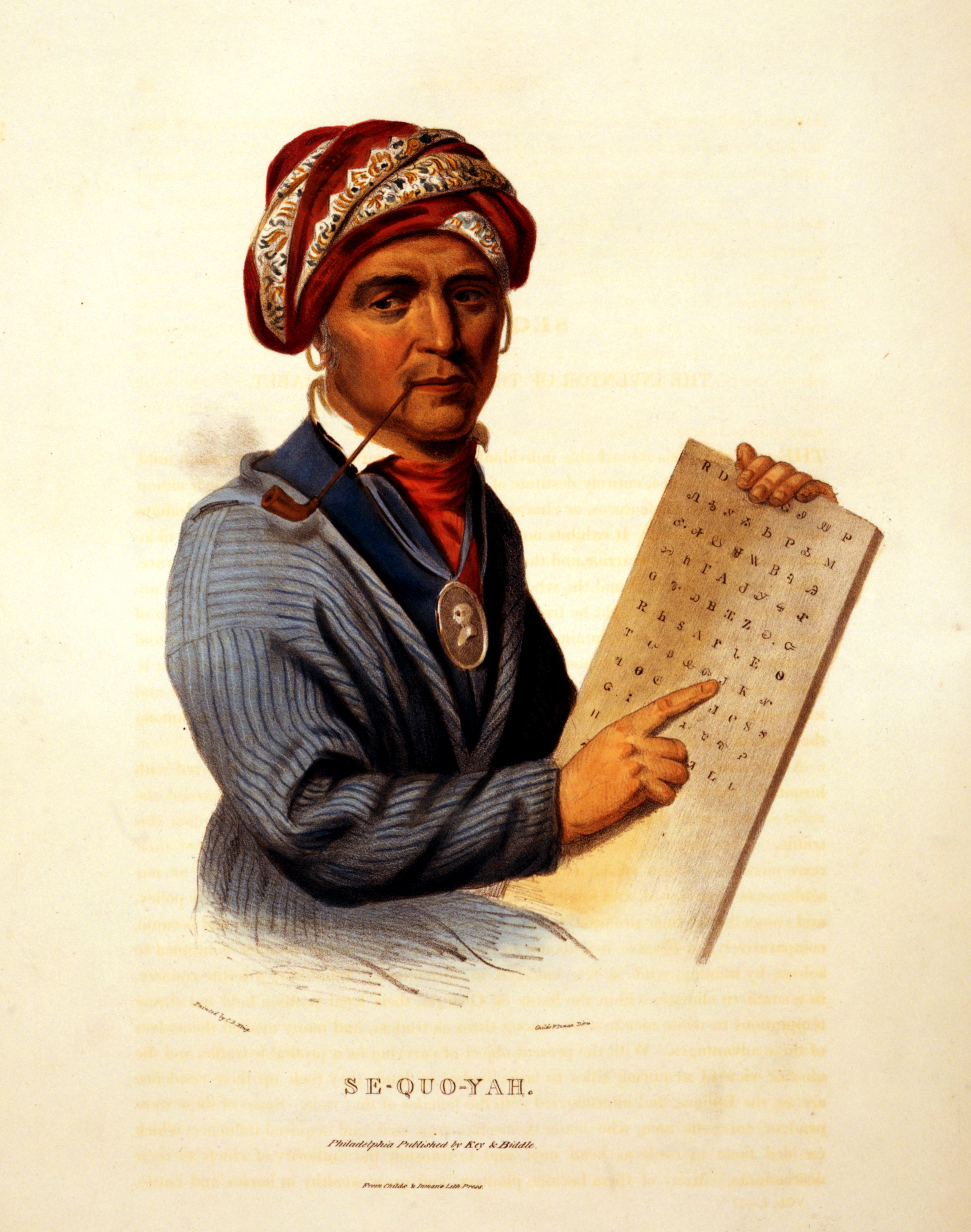 |
Portrait of Sequoyah (ᏍᏏᏉᏯ) and his syllabary in 1836.
Charles Bird King [Public domain], via Wikimedia Commons |
1824 - The
Bureau of Indian Affairs was created.
The Indian Office: Growth and Development of an American Institution, 1865 - 1900 by Paul Stuart
The Office of Indian Affairs, 1824-1880 by Edward E. Hill
1830 - Congress passed the
Indian Removal Act.
1831 - Supreme Court ruled that Indian tribes are domestic dependent nations in
Cherokee Nation v. Georgia.
1832 - Supreme Court ruled that state laws do not apply to Indian tribes in
Worcester v. Georgia.
1836 -
Removal of Creek Indians.
1838 - Cherokee removed via the infamous
Trail of Tears.
The Cherokee Removal: a Brief History with Documents by Theda Perdue
Indian Removal: the Emigration of the Five Civilized Tribes of Indians by Grant Foreman
The Politics of Indian Removal: Creek Government and Society in Crisis by Michael D. Green
The Trail of Tears and Indian Removal by Amy H. Sturgis
1851 - United States began the
Reservation System to confine Native American tribes to designated tracts of land.
Indians and Indian Agents: the Origins of the Reservation System in California, 1849-1852 by George Harwood Phillips
1864 - Colorado militia attacked a peaceful encampment of
Cheyenne and
Arapaho Indians
massacring approximately 200 to 300 people including women and children.
The Sand Creek Massacre by Stan Hoig
1866-68 -
Lakota (also known as the Sioux), Northern Cheyenne, and Arapaho forces defeated the US military in
Red Cloud's War. The
Treaty of Fort Laramie of 1868 formally ended the war and guaranteed Lakota ownership of the
Black Hills.
Crazy Horse: a Lakota Life by Kingsley M. Bray
Red Cloud: Warrior-Statesman of the Lakota Sioux by Robert W. Larson
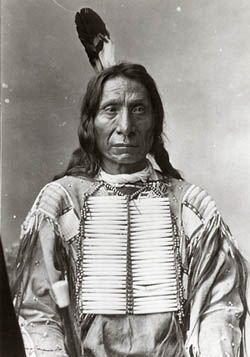 |
Picture of Red Cloud, Oglala Lakota chief, taken in 1880.
By Charles Milton Bell (http://www.sd4history.com/Unit4/redcloud.htm) [Public domain], via Wikimedia Commons |
1871 - Congress passed the
Indian Appropriations Act ending the treaty system. After passage of this act relations between federal government and Indian tribes were managed through acts of Congress rather than treaties.
1874-75 - US defeated the Comanche in the Red River War, which was fought largely in the Texas panhandle.
Battles of the Red River War: Archaeological Perspectives on the Indian Campaign of 1874 by J. Brett Cruse
Comanche Empire by Pekka Hämäläinen
Quanah Parker, Comanche Chief by William T. Hagan
1876-77 - US defeated Lakota and their allies in the Great Sioux War, even though Sitting Bull led the Lakota in victory against General George Custer at the Battle of Little Big Horn.
Battles and Skirmishes of the Great Sioux War, 1876-1877: the Military View by Jerome A. Greene
Lakota and Cheyenne: Indian Views of the Great Sioux War, 1876-1877 by Jerome A. Greene
The Last Days of George Armstrong Custer: the True Story of the Battle of Little Bighorn by Thom Hatch
Sitting Bull and the Paradox of Lakota Nationhood by Gary Clayton Anderson
1877 - US defeated the Nez Percé.
Chief Joseph & the Flight of the Nez Perce: the Untold Story of an American Tragedy by Kent Nerburn
1886 - US defeated the
Apache.
The Apache Wars: the Hunt for Geronimo by Paul Andrew Hutton
Geronimo: the Man, His Time, His Place by Angie Debo
1887 - Congress passed the
Dawes Severalty Act. It ended tribal ownership of land and provided tracts to individual Native Americans instead. The result was a drastic reduction of Indian land, much of which was sold to white settlers.
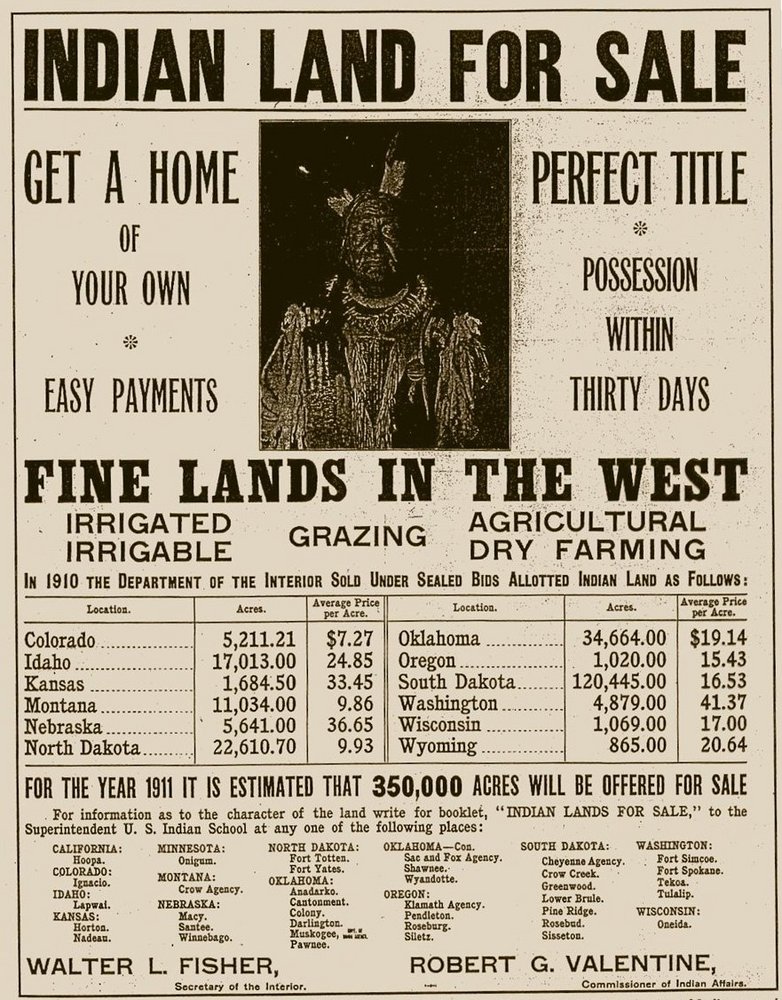 |
Poster advertising Indian land for sale in 1911.
By United States Department of the Interior [Public domain], via Wikimedia Commons |
1890 - Increasing popularity of
Ghost Dance religion caused fear among the white community, which culminated at a massacre of approximately 150 Lakota men, women, and children by the US military at
Wounded Knee.
American Carnage: Wounded Knee, 1890 by Jerome A. Greene
The Ghost Dance: Origins of Religion by Weston La Barre
The Lakota Ghost Dance of 1890 by Rani-Henrik Andersson
Wounded Knee Massacre by Marty Gitlin
- According to the National Archives
Records of Right webpage: "To encourage assimilation into white society, in 1890 the government began requiring Native American children to attend
schools that were often hundreds of miles away from reservations."
American Indian Education: a History by Jon Allan Reyhner and Jeanne M. Oyawin Eder
Pipestone: My Life in an Indian Boarding School by Adam Fortunate Eagle
1893 -
Charles Curtis, of Kansas, became the first Native American to serve in Congress. He was a member of the
Kaw tribe. In 1907, he became the first Native American to serve in the Senate, and in 1929 he became the first and only Native American to serve as Vice President of the United States.
1917-18 - Approximately
12,000 Native Americans served in the US military during World War I.
American Indians in World War I: at Home and at War by Thomas A. Britten
North American Indians in the Great War by Susan Applegate Krouse
1924 - Congress passed the
Indian Citizenship Act, which granted citizenship to all Native Americans born within the territorial limits of the United States.
 |
Charles Curtis, member of the Kaw Nation, served as Vice President of the United States from 1929-1933.
By Strauss Peyton, Kansas City, Missouri [Public domain], via Wikimedia Commons |
1941-45 - Approximately
25,000 Native Americans served in the US military during World War II, such as the
Navajo Code
Talkers.
American Indians and World War II: Toward a New Era in Indian Affairs by Alison R. Bernstein
Code Talker Stories by Laura Tohe
The Comanche Code Talkers of World War II by William C. Meadows
1953 - Congress passed a resolution adopting policy of
terminating tribal sovereignty.
1968 - The
American Indian Movement (AIM) was founded to promote Native American civil rights.
1969-71 Native American activists seized control of the abandoned federal prison
Alcatraz.
1973 - Approximately 300 armed Native American activists seized control of
Wounded Knee to protest poor living conditions and corrupt officials on the reservation. This led to a 71 day standoff with federal officials which led to the deaths of two activists.
1975 - AIM member
Leonard Peltier convicted of murdering two federal agents in a controversial trial.
Laud Hawk: the United States versus the American Indian Movement by Kenneth S. Stern
The Trial of Leonard Peltier by James W. Messerschmidt
Where White Men Fear to Tread: the Autobiography of Russell Means by Russell Means
Wounded Knee 1973: a Personal Account by Stanley David Lyman
-
Indian Self-Determination and Education Act of 1975 granted tribes money to administer federal programs, which began the reversal of the termination policy.
1985 -
Wilma Mankiller became the first woman elected chief of the Cherokee Nation.
Beloved Women: the Political Lives of LaDonna Harris and Wilma Mankiller by Sarah Eppler Janda
The Reader's Companion to U.S. Women's History by Wilma Pearl Mankiller
1988 - Congress passed the
Indian Gaming Regulatory Act.
Indian Gaming: Tribal Sovereignty and American Politics by W. Dale Mason
1994 - Congress passed the
Tribal Self Governance Act.
2009 - The
Cobell v. Salazar case was settled. Representatives of several Native American tribes sued the federal government in 1996 for mismanagement of Indian lands and funds. In 2009, the federal government agreed to settle the case and pay over $3 billion in damages.
2016 - Native Americans, concerned about contamination of their water at the
Standing Rock Indian Reservation, protested the location of the
Dakota Access oil pipeline.
 |
Map of Indian reservations, and other designated areas, as of the 2000 Census.
Created by the US Census Bureau [Public Domain] |
Tarleton State University's Dick Smith Library has a wealth of books and other resources relevant to Native American history and culture. Such as these titles:
1491: New Revelations of the Americas before Columbus by Charles C. Mann
American Indian Food by Linda Murray Berzok
American Indians in U.S. History by Roger L. Nichols
Carvings and Commerce: Model Totem Poles, 1880-2010 by Michael D. Hall
Daily Life During the Indian Wars by Clarissa W. Confer
The Forced Removal of American Indians from the Northeast by David W. Miller
Indian Slavery in Colonial America by Alan Gallay
Malinche, Pocahontas, and Sacagawea: Indian Women as Cultural Intermediaries and National Symbols by Rebecca K. Jager
Native North American Art by Janet Catherine Berlo
Peyote Religion: a History by Omer Call Stewart
The Texas Indians by David La Vere
White Man's Paper Trail: Grand Councils and Treaty-Making on the Central Plains by Stan Hoig
If you need assistance finding resources on this, or any other topic, then please contact us at 254-968-9249 or reference@tarleton.edu.



.jpg)


