Showing posts with label genealogy. Show all posts

Tuesday, April 5, 2016

Ancestry.com Texas

Did you know?

Free access to Texas State Library and Archives Commission (TSLAC) records that have been digitized by Ancestry is available to Texas residents. 


Go to https://www.tsl.texas.gov/arc/ancestry and follow the instructions given on that page!  I have a membership with Ancestry.com, but I followed these steps to successfully create a free account for access to these Texas records only for my husband.

1.  Enter your Texas zip code at the bottom of the web page linked to above, and click Submit.


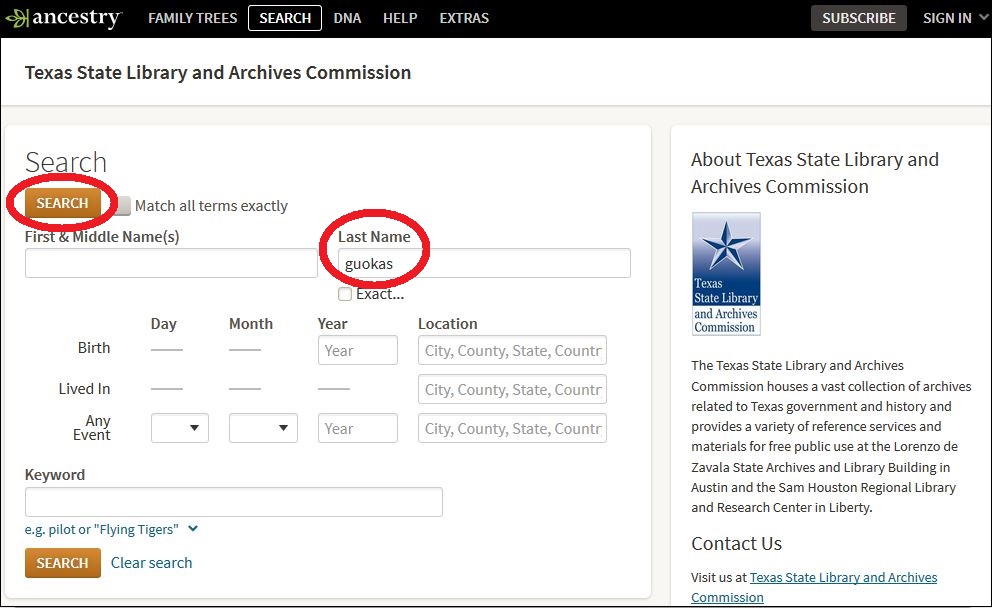
2. This will open a page like the one below.  Do a search first - ideally a last name - as you need to search for something to get to the next page, in order to create the free account.  I chose to search a unique last name in my family tree (my native Houstonian mother's maiden name, as her grandfather by that name settled in Texas about 1880).  Enter your search term, and then click the Search button:


3.  You will get a page with some results.  None may pertain to your family, but at this stage, it does not matter.  Click on the name of the result (NOT on "View image"!).  In this case, I actually got a relevant result - Anton Guokas is my great-grandfather's brother, so I clicked on "Texas, Prison Employee Ledgers, 1861-1938" opposite his name:


4.  At this point, you should see a screen inviting you to create a free account. Click the link to sign up with your e-mail address.  Do not click on any “Start A Free Trial” button. If you have an existing Ancestry.com Texas or paid account you may proceed to the “Sign In” link in the upper right corner.


5.  Enter your name and e-mail address, create a password (no rules!), and click the Continue button:


6. You can now access the result you clicked on, and view its image, save it and create a family tree, print it, and in some cases share it, and search for other records from TSLAC.  You'll see your name appearing in the upper right corner.  Note, however, that you can't access many of the links below it on the right without a paid Ancestry.com account.  Some, such as the 1940 Census and the Find A Grave index, ARE free, but most will required a paid membership.


For more information, check the Frequently Asked Questions on the Ancestry.com Texas web page.  To avoid frustration getting lots of results for records you can't access without a paid membership, it is recommended that you go to the Ancestry.com Texas web page, enter your zip code, and then sign in in the upper right-hand corner each time you use the site..

Tuesday, October 27, 2015

October is (Also) Family History Month

Besides being #ArchivesMonth, October is also Family History Month, and we have a number of databases and other resources here at Tarleton that can help you research your own family history.  Check out our Genealogy Research Guide for suggestions as well as a link to a web page with other helpful resources.

If you need help using any of these databases or other resources, see our Coordinator for Archives and Special Services (and amateur genealogist) Amanda Pape, on the lower level of the Dick Smith Library, call her at 254-968-9251, or (best) e-mail her at pape@tarleton.edu.

And don't forget that TODAY, Tuesday, October 27th, from 12:10 p.m. to 12:50 p.m. in the Library's Multipurpose Room, the Library will be hosting a Brown Bag presentation on "Preserving Your Family History and Treasures" by our archivist Gary Spurr.  Please feel free to bring your lunch!  We hope to see you there. 


Tuesday, October 21, 2014

Heritage Quest Census Maps

It's still Family History Month, so here's a little tip I learned about the library's Heritage Quest Online database in a recent online webinar:

After logging in, choose Census and Browse.  After you choose a census year and state, a link will appear that says "View State Map."


When you click on the link, it opens a new window with a map of that state.  Current counties are outlined in white; counties for the census year are outlined in black.

Texas in 1860

In 1850 (pictured at left), Erath county (of which Stephenville is the county seat) didn't exist.  It - and part or all of many of today's surrounding counties - were part of a then-huge Milam county.

By 1860 (pictured below), some boundaries had changed.  Erath County's boundaries are close to what they are now.  Adjacent Hood and Somerville counties were part of Johnson County in 1860.  The maps also note information such as the fact that all census records for Tarrant County (Fort Worth) were lost for 1860.
Texas in 1860
Texas in 1870


For the 1870 census (pictured below), Erath County has the shape it has today.  However, apparently there are no records for adjacent Palo Pinto County - indications are that it was not enumerated separately, and perhaps was not enumerated at all.

These handy maps can help the researcher figure out where to look for ancestors.

Thursday, October 2, 2014

October is Family History Month!

October is Family History Month, and we have a number of databases and other resources here at Tarleton that can help you research your own family history.  Check out our Genealogy Research Guide for suggestions as well as a link to a web page with other helpful resources.

Pape & Guokas Family Tree as of August 2014 / Amanda Pape / CC BY-NC-ND 4.0

FamilySearch, a FREE website with a millions of records, has a number of suggestions for ways to celebrate this month, including beginning to record your own memories for your descendants.

ProQuest, a company that provides both HeritageQuest Online and Texas Digital Sanborn Maps, is offering free webinars for anyone this month who would like to learn more about using these databases.  Check out the schedule here.

If you need help using any of these databases or other resources, see our Coordinator for Archives and Special Services (and amateur genealogist) Amanda Pape, on the lower level of the Dick Smith Library, call her at 254-968-9251, or (best) e-mail her at pape@tarleton.edu.

Wednesday, October 9, 2013

October is Family History Month!

Free Five Generation Family Tree Fan Chart from About.com

October is Family History Month, and we have a number of databases that can help you research your own family history.  Here are some of my favorites:

Archive of Americana is one of the library's databases that provides access to primary-source historical materials such as newspapers, government documents, and other publications.  This database includes American Historical Newspapers (most of which only go through 1922 due to copyright), and the Dallas Morning News - Historical, which includes issues from October 1, 1885, through December 31, 1984.  (Issues from August 12, 1984 to today's can be found at the Dallas Morning News - Current link.)  For a brief tutorial on using the Archive of Americana database, check out this post from February 2012.

Newspapers are a great source of family history information.  You'd be surprised at how much information can be found in the New York Times - Historical (1851-2009), even if your ancestors did not live in New York City.  If you or ancestors were affiliated with Tarleton (or even from Stephenville), check out our J-TAC Newspaper Archive (1909-2009).  This connects you to the Portal to Texas History, where photographs, maps, newspapers, yearbooks, documents, and other materials from Texas libraries, museums, archives, historical and/or genealogical societies, and private family collections have been digitized and indexed in this free online database.

Speaking of Texas - the Handbook of Texas Online has historical information and sources that can help you with your research, and Texas Digital Sanborn Maps has early maps (1867-1970) of towns and cities in Texas.

Another database to check is the Biography and Genealogy Master Index, which indexes current reference sources as well as the most important retrospective works that cover individuals, both living and deceased, from every field of activity and from all areas of the world.  If we don't have the listed reference source in our collection, talk to me or another librarian about obtaining what you need through interlibrary loan.

Three of our newest databases are African American Archives, American Revolutionary War Archives, and World War II Archives, all accessed through the first link.  These provide you with material at the Fold3 subscription database site, "the web's premier collection of original military records."  Of particular interest are the World War II Hero pages, with primary-source documents, first-hand accounts, photos, timelines, and maps for over 8.8 million men and women who served in this conflict.

Finally, we have HeritageQuest Online.  This database allows you to search indexed U.S. Census records from 1790 through 1940, over 28,000 family and local history books, and over 2.3 million genealogy and local history articles from 1800 to 2009, as well as Revolutionary War pension and bounty land warrant application files, and Freedman's Bank records from 1865 to 1874.

If you need help using any of these databases, see our Coordinator for Archives and Special Services (and amateur genealogist) Amanda Pape, on the lower level of the Dick Smith Library, call her at 254-968-9251, or (best) e-mail her at pape@tarleton.edu.


Monday, August 6, 2012

1940 US Census is Searchable Now!

Just four months after it was released to the public on April 2, the 1940 United States Census has been indexed and is searchable by name on a number of websites.  Ancestry.com, the subscription genealogy website, is providing free access to the 1940 Census for a year.  In addition, a number of other companies and organizations partnered with the National Archives to make the images available to the public.  FamilySearch.org, an always-free genealogy website, used volunteers (I was one of them!) to index the census.  The last few states indexed are being quality-checked and will be posted on their site (as well as on Archives.com and FindMyPast.com) soon.

If you are searching for your ancestors in the 1940 Census, I recommend you try both Ancestry.com and FamilySearch.org.  Why?  Indexers aren't perfect.  Sometimes it's tricky to read an enumerator's handwriting, and interpretations differ.  (Not to mention, enumerators often misheard and misspelled names).  If you can't find your relative on one site, try the other.  If you need help, see Amanda Pape, Special Services Librarian, on the lower level of the Dick Smith Library.


Monday, March 5, 2012

The 1940 US Census

It's your America! Help the ten-year
roll call--1940 census, U.S.A.

United States. Bureau of the Census,
U.S. Government Printing Office,
circa 1940.  Library of Congress
Prints and Photographs Division.
Four weeks from today, on Monday, April 2, at 8 AM Central time, the 1940 US Census will be released digitally.  Genealogists (like me) and historians have been waiting for this, as the 1940 (and later) original census forms have not been available for public use because of a statutory 72-year restriction on access for privacy reasons.  The digital images will be available for viewing and download for FREE at the National Archives and Records Administration (NARA) special 1940 US Census website, 1940census.archives.gov.

The 1940 US Census, officially occuring on April 1, 1940, asked the typical questions from earlier censuses: name, age, gender, race, education, and place of birth. But the 1940 US Census also asked some new questions. Lingering concerns from the Great Depression were reflected in numerous questions about employment status for those age 14 and older.  For example:

There was also a question about income for the 12 months ending December 31, 1939, as well as one asking where one was living on April 1, 1935 (which will be a gold mine for genealogists!).

The 1940 also has a "supplemental schedule" for two names on each page, the persons enumerated on lines 14 and 29 (about a 5% sample of the population). The supplemental schedule is a section with additional questions to ask these two people.  It asks the place of birth of the person's father and mother; the person's usual occupation, not just what they were doing the week of March 24-30, 1940; and for all women who are or have been married, has this woman been married more than once and age at first marriage.

The 1940 US Census will not have a name index when it opens on April 2, 2012.  FamilySearch.org, a free website, plans to create a free name index of the 1940 US Census after it opens. You can sign up NOW to be a 1940 US Census indexer. In the meantime, you can get some practice by indexing other records through FamilySearch Indexing.

I have been a FamilySearch indexer for a few months now.  It involves downloading some software to your computer, then downloading batches, indexing them, and uploading them back to the FamilySearch indexing website.  It's been rewarding to see records I've indexed actually appear later on the FamilySearch site.  If you follow the detailed instructions with each batch, you will be successful and will help others access all sorts of records - lately I've been working with Texas birth records from the early 1900s.

Until name indexes are available, you will need to know the address of the person you are searching for and the Census enumeration district (ED) in which that address was located.  Initially, the 1940 Census WILL be indexed down to the ED level.  So, if you know the 1940 ED for an ancestor or relative, it will shorten your search considerably.  There are a number of tools available to help you figure out EDs.  The National Archives has a web page with links to various other sites and utilities for determining 1940 EDs.  There are other suggestions on the National Archives website on how to prepare to do research in the 1940 US Census.

Wednesday, February 15, 2012

Archive of Americana

Archive of Americana is one of the library's databases that provides access to primary-source historical materials such as newspapers, government documents, and other publications.  Many of the newspapers in this collection go through 1922, but the Dallas Morning News is included through January 1984.  Here's a brief demo on using it for family history research - click on each image for a larger view:
My great-grandfather immigrated to Texas sometime after 1880, so I did a search (above) on his (unusual) last name and limited it to 1880-2012 (see the red box in the image above).

In the image at left, only five of the 132 results are visible.  Click on the "View all [whatever number] link in the bottom left corner (again, in the red box in the image).

This should (it doesn't always) bring up preview images from the documents that include one or more of your search terms.  If you see something promising, you can click on the preview or on the "View Article" link (see the red boxes in the image below).


When you find an article, you will find a number of tools at the top right of the page.  The "Article Bookmark" link opens a new window containing the OpenURL for the article. You can copy and paste this OpenURL information into another application.  The "Export Citation" link opens a new window containing a simple, text-only format of the citation information for the article. You can also Email the OpenURL link for the document.

You can zoom in or out, reposition the image in the viewing pane, view the full page the article was published on, and reset the image view to the default.  You can also open the article as a PDF, open it in a print-friendly view, and maximize (or minimize) the image view pain.

You can also add the article to "My Collection," a temporary saving space that's held until you log off.

Your search term(s) will be highlighted in yellow. There is a check box at the top left of the screen to toggle that feature on or off. 

The database has a very informative "Help" page that explains all of its features.

Give this database a try for your pre-1922 ancestors, as well as Texas family through 1983.  I was expecting to find my grandfather's cousin who lived in the Dallas area (and I did).  I did not expect to find this article (pictured left) about my grandfather, who never lived in the Metroplex but only in Houston and Austin!

Friday, August 5, 2011

Portal to Texas History

The Portal to Texas History is a great resource for Texas history and genealogy materials.  Photographs, maps, newspapers, yearbooks, documents, and other materials from Texas libraries, museums, archives, historical and/or genealogical societies, and private family collections have been digitized and indexed in this free online database. 

One of the collections is that of our very own J-Tacs from 1919 through 2007.  You can search for a name and it will be highlighted on the pages of the issues in which it appears.

The Portal also has some great "Resources 4 Educators," including lesson plans and other learning materials for teachers and students. 

Monday, July 18, 2011

Sometimes you can't get it online

I'm an amateur genealogist, working on my family history.  I've been trying to track down a couple of elusive relatives and determine if they are indeed mother and daughter.  I've looked for a birth certificate or birth registry entry on free websites like FamilySearch.org and the Clerk of Cook County (Illinois; the daughter's birthplace) website, and on paid sites like Ancestry.com and Heritage Quest, but I haven't had any luck.

I have been able to narrow down the year in which the daughter was born, and I checked the catalog of the Family History Library in Salt Lake City.  What I'm looking for, the "Registers of births outside of the city [Chicago], 1878-1894," is only available on microfilm.  Luckily, I can have that reel of microfilm sent to my local FamilySearch Center at a nominal cost, and I can look at it there.

So what is my point in telling you this story?  Sometimes the information you need is not available online, and you have to e-mail, call, or go to the library to get it.  Come see us or contact us at the Dick Smith Library - we're glad to help you!

Wednesday, November 18, 2009

Looking for my Grandfather

In my last entry, I talked about how to arrange and preserve your family archives. This time I will give you some sources for finding out more about your family. These are by no means all of the resources available to those researching their family. For information about ancestors who fought in the Civil War a good starting place is the National Park Service's Civil War Soldiers & Sailors System http://www.itd.nps.gov/cwss/index.html . Here you can find information about what unit they were in and information on the unit. The Texas General Land Office Searchable Texas Land Grant Database allows you to see if family members have received a Texas land grant. The grants in the database go back to the Texas Republic. http://www.glo.state.tx.us/archives/landgrant.html

The Texas State Archives and Library Commission genealogy page at: http://www.tsl.state.tx.us/arc/genfirst.html offers links to several searchable databases. One of those that are helpful to genealogists is the County Records on Microfilm http://www.tsl.state.tx.us/arc/local/index.html The majority of the counties in Texas have had their records microfilmed. The microfilm is held at various depositories throughout the state and can be borrowed through Inter Library Loan (ILL), if you cannot visit the repository. Just click on the link above for a list of counties, and then click on the county you are interested in for a list of the records and where the microfilm is held. When requesting microfilm through ILL you need to provide the name of the county, the roll number, and the title of the roll.

Other databases at the Texas State archives site are listed below:

There are too many links to list in this brief blog, but I will mention a few. In the most requested box on the home page listed above are links to military records where a person can request a copy of the DD Form 214 report of Separation and other records electronically, by fax, or mail. Clicking on the genealogy/getting started link takes you to a wealth sources at the National Archives many of which are searchable online including the Dawes Rolls Index and Final Roll for those researching their Native American ancestry.

Hope these tips will help you and if you have any questions contact me at: spurr@tarleton.edu