Showing posts with label Library of Congress. Show all posts

Tuesday, September 19, 2017

Hispanic Heritage Month


September 15th through October 15th is National Hispanic Heritage month. This is the time to recognize the contributions and experiences of Americans of Hispanic heritage. According to the National Hispanic Heritage Month website, hosted by the Library of Congress, "September 15 is significant because it is the anniversary of the independence for Latin American countries Costa Rica, El Salvador, Guatemala, Honduras and Nicaragua. In addition, Mexico and Chile celebrate their Independence days on September 16th and 18th respectively."

2010 US Census Hispanic Population by County
Percentage of Hispanic or Latino population by county in 2010 census.
By United States Census Bureau [Public domain], via Wikimedia Commons.
Hispanic Americans are a large and quickly growing segment of the US population. In 2003, Hispanics became the largest minority group in the United States. The 2010 census counted 50,477,594 Americans of Hispanic or Latino origin. That's 16.3% of the total US population and a 43% increase from the 2000 census count.

Timeline of Hispanic-American History
Click on the links below to find relevant library resources on each topic.

1493: Christopher Columbus began Spanish colonization of Puerto Rico.
1513: Juan Ponce de León led first expedition to Florida.
1528 – 1536: Alvar Núñez Cabeza de Vaca survived an ill-fated expedition and explored portions of Texas. His book was the first written account of Texas Indians.
1539 – 1542: Hernando de Soto explored Southeast US including portions of Florida, Georgia, South Carolina, North Carolina, Tennessee, Alabama, and Mississippi. The Hernando de Soto Expedition by Jerald T. Milanich. Francisco Vásquez de Coronado explored Southwest US including portions of Arizona, New Mexico, Texas, Oklahoma, and Kansas. Documents of the Coronado Expedition, 1539 – 1542 by Richard and Shirley Cushing Flint.
1565: Pedro Menéndez de Avilés established a colony at Saint Augustine, Florida.
·         America’s Ancient City: Spanish St. Augustine, 1565 – 1763 by Kathleen A. Deagan
1598: Juan de Oñate led Spanish colonization of New Mexico.
1610: Santa Fe established as capital of New Mexico.
·         Santa Fe: History of an Ancient City by David Grant Noble
1718: Spanish colonists founded San Antonio, Texas.  
·         San Antonio de Béxar: a Community on New Spain’s Northern Frontier by Jesús F. de la Teja
·         Spanish Texas, 1519 – 1821 by Donald E. Chipman
      1748 - 1755: José de Escandón led the Spanish colonization of Nuevo Santander (which today includes the Mexican state of Tamaulipas and portions of southern Texas). He established several settlements in the region including Laredo, TX. 
·            De León: a Tejano Family History by A. Carolina Castillo Crimm
    Notable Men and Women of Spanish Texas by Donald E. Chipman and Harriet Denise Joseph 
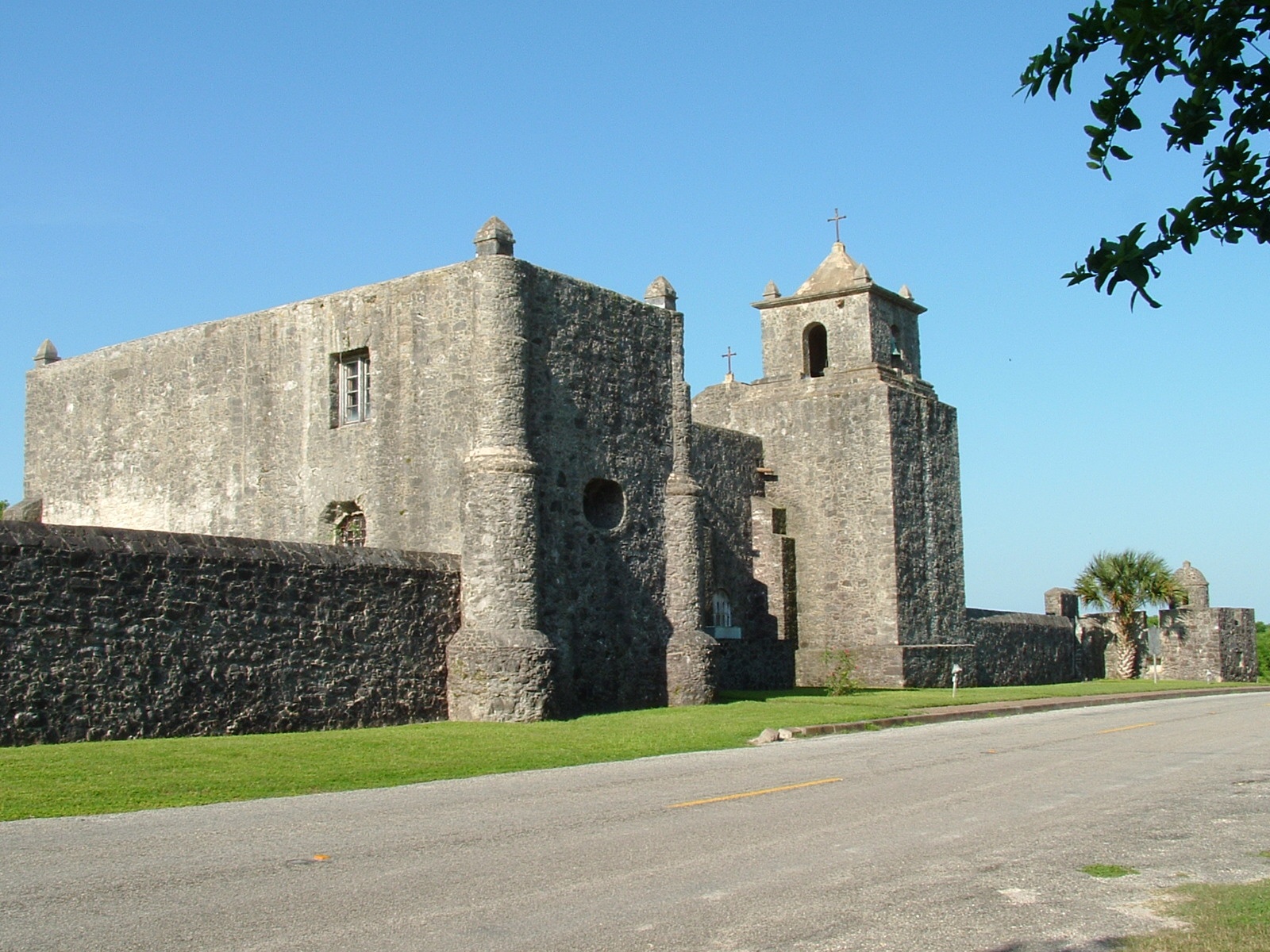
Presidio La Bahía near Goliad, TX. Originally built by the Spanish in 1721, and later rebuilt in 1771.
 Photo by Ernest Mettendorf - Public Domain, https://commons.wikimedia.org/w/index.php?curid=4208460
1769 – 1819: Spain established multiple settlements in California including San Diego (1769), San Francisco (1776), and Los Angeles (1781).
·         A History of California: the Spanish Period by Charles E. Chapman
1821: United States purchased Florida from Spain.
·         Diplomacy and the Borderlands: the Adams-Onís Treaty of 1819 by Philip Coolidge Brooks  
 Mexico won independence from Spain.
·         The Hidalgo Revolt: Prelude to Mexican Independence by Hugh M. Hamill
1822: Joseph Marion Hernández became first Hispanic to serve in the US Congress. He was a delegate from the Florida Territory.
1836: Texas declared independence from Mexico.
1845: United States annexed Texas.
·         The Annexation of Texas by Justin Harvey Smith
1848: Treaty of Guadalupe Hidalgo ended the Mexican-American War. Mexico ceded territory to US including: California, Arizona, New Mexico, Nevada, Utah, and portions of Colorado, Kansas, Oklahoma, and Wyoming. 
   The Border Crossed Us: Rhetorics of Borders, Citizenship, and Latino/a Identity by Josue David Cisneros. 
·         Border Visions: Mexican Cultures of the Southwest United States by Carlos G. Vélez-Ibañez
·         The Treaty of Guadalupe Hidalgo: a Legacy of Conflict by Richard Griswold del Castillo
1859: Juan Cortina seized control of Brownsville, TX in retaliation for town marshal’s assault on one of his employees.
·         Cortina: Defending the Mexican Name in Texas by Jerry D. Thompson
·         Juan N. Cortina: Two Interpretations by Charles William Goldfinch
1875: Romualdo Pacheco became the first Hispanic governor of a US state (California). 
1877: A white mob killed approximately 40 Mexican-Americans in Nueces County, Texas.
          Forgotten Dead: Mob Violence against Mexicans in the United States, 1848-1928 by William D. Carrigan and Clive Webb.   
1889: The Herrera brothers (Pablo, Nicanor, and Juan Jose) formed a resistance movement known as Las Gorras Blancas to protect Hispanic land from Anglo squatters in New Mexico.
1898: Spain ceded control of Puerto Rico to the United States at the conclusion of Spanish-American War.
·         Spanish-American War by Michael Golay
1910 – 1920: Revolution in Mexico resulted in increased Mexican immigration to US.
·         Pancho Villa at Columbus by Haldeen Braddy
1917: Puerto Ricans granted US citizenship.
1928: Octaviano Larrazolo, from New Mexico, became first Hispanic to serve in the US Senate.
1929: League of United Latin American Citizens (LULAC), which advocates for Latino civil rights, founded in Corpus Christi, TX.
·         LULAC, Mexican Americans, and National Policy by Craig Allen Kaplowitz
1942:  Due to labor shortage caused by World War II, US entered into an agreement with Mexico (known as the Bracero Program) to import Mexican laborers into the US.
   Harvest of Loneliness: The Bracero Program – documentary film.
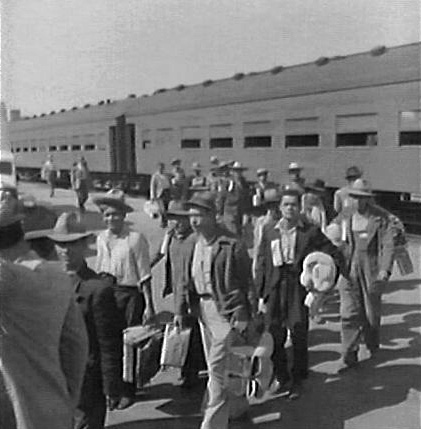
The first Braceros arriving by train in Los Angeles, CA in 1942.
By Dorothea Lange, working for the US Government. [Public domain], via Wikimedia Commons. 
1943: Zoot Suit Riots in Los Angeles, CA.
·         Murder at the Sleepy Lagoon: Zoot Suits, Race, and Riot in Wartime L.A. by Eduardo Obregón Pagán
1945: Marcario García became first Mexican immigrant to be awarded the US Congressional Medal of Honor.
1948: Dr. Hector P. García founded the American G.I. Forum in Corpus Christi, TX to advocate for the civil rights of Hispanic veterans. The group gained national attention advocating on behalf of the family of Felix Longoria after a funeral home in Three Rivers, TX refused to bury him. 
1954 – 1958: US government implemented “Operation Wetback” and deported millions of people of Mexican descent.
1959: Fidel Castro’s successful revolution in Cuba resulted in increased Cuban immigration to US.
·         The Cuban Revolution: Origins, Course, and Legacy by Marifeli Pérez-Stable
1962: César Chávez and Dolores Huerta founded the United Farm Workers to advocate for the rights of migrant farm workers.
·         The Moral Vision of César Chávez by Fredrick John Dalton
·         Dolores Huerta: A Hero to Migrant Workers by Sarah E. Warren and Robert Casilla
1964: Bracero Program ended.
1965 – 1970: United Farm Workers conducted a successful strike on behalf of grape pickers in California.
·         Delano, the Story of the California Grape Strike by John Gregory Dunne
1968: Thousands of Hispanic students walkout of schools in Los Angeles, CA to protest unequal educational opportunities. Walkouts spread to hundreds of schools in multiple states.
1988: Lauro Cavazos became the first Hispanic to serve in the United States Cabinet. He served as Secretary of Education.
2003: Hispanics became largest minority group in the United States.
2009Sonia Sotomayor became the first Hispanic to serve on the Supreme Court of the United States. 
President Obama and Sonia Sotomayor meeting in the Oval Office in 2009.
By Official White House photo by Pete Souza from Washington, DC (Flickr) [Public domain], via Wikimedia Commons

The Dick Smith Library has a large collection of books and other resources on topics relevant to the Hispanic American experience. Such as these titles: 
The Mexican Americans by Alma M. García
The Spanish Americans of New Mexico: a Heritage of Pride by Nancie L. Solien Gonzalez. 

Let us know if you need assistance finding additional information by calling 254-968-9249 or emailing at reference@tarleton.edu

Monday, June 19, 2017

Erath County Sheriff Murdered 140 Years Ago to be Honored

This coming Sunday, June 25, a ceremony will be held to dedicate a monument on the east side of the county courthouse to the first known peace officer in Erath County killed in the line of duty, James Mastin.  Free electronic resources at the Portal to Texas History and the Library of Congress website were used to find out more information about his murder and the aftermath.


Two references to his murder were on the same page (two)1  of the July 5, 1877, issue of the Weekly Democratic Statesman, published in Austin, Texas, found via the Portal to Texas History.  The search was for "mastin erath" (without the quotes) with results limited to the year 1877.  The first reference started at the bottom of column six and continued at the top of column 7.  Sheriff Maston [sic] was killed by a cattle thief he intended to arrest:


Further on in column seven was a little more detail.  This time Mastin's name was spelled correctly, and it gave the date of the murder, June 25.  The name and a detailed description of the murderer, Bone Wilson, was also given, as well as the fact that a reward was being offered for his capture.  This story also noted Mastin was going to arrest Wilson for stealing a horse (not cattle theft):


A follow-up story2 was in the Galveston Daily News of September 27, 1877, on page 4.  In a section with news from Erath County, the Stephenville Empire newspaper was quoted. (In the image below, a number of lines of news not relevant to this case have been blanked out.)  Bone Wilson, alias Napoleon B. Wilson, was killed by Texas Rangers under the command of T. M. Sparks about 20 miles from Fort Chadbourne on September 15, 1877:


A little more detailabout the murderer’s death comes from the Lampasas Dispatch of September 27, 1877, via the Brownwood Banner.  This one was found by searching the Portal to Texas History for “sheriff erath” (no quotes in the search), as Mastin was sometimes spelled incorrectly.  This article does not even refer to the sheriff by name, and some of the details of Wilson's killing are different.  Both articles note that Wilson's body was taken to Coleman City (just established in 1876). which is about 60 miles east of the fort.


There’s more about Mastin on pages 15-16 of James Pylant’s 2009 book, Sins of the Pioneers4.  He was elected sheriff on February 15, 1876, and had survived an earlier attempt on his life in November of that year "when Rufus C. Howie fired a six-shooter at him."

One of Pylant’s sources5 is an account of the killing of Mastin’s murderer, Bone Wilson, by one of the Texas Rangers participating, Noah Armstrong.  Armstrong was interviewed sometime between 1936 and 1939, as part of the Folklore Project of the Federal Writers’ Project, a New Deal jobs program that was part of the U.S. Works Progress (later Work Projects) Administration (WPA).  His account of the killing of Bone Wilson starts on the fourth page.


Sources:

1Weekly Democratic Statesman. (Austin, Tex.), Vol. 6, No. 39, Ed. 1 Thursday, July 5, 1877, newspaper, July 5, 1877; Austin, Texas. (texashistory.unt.edu/ark:/67531/metapth277635/m1/2/?q=mastin+erath: accessed January 21, 2017), University of North Texas Libraries, The Portal to Texas History, texashistory.unt.edu; .                                                          

2The Galveston Daily News. (Galveston, Tex.), Vol. 36, No. 161, Ed. 1 Thursday, September 27, 1877, newspaper, September 27, 1877; (texashistory.unt.edu/ark:/67531/metapth464966/m1/4/?q=mastin%20erath: accessed January 21, 2017), University of North Texas Libraries, The Portal to Texas History, texashistory.unt.edu; crediting Abilene Library Consortium.

3Beall, W. P. The Lampasas Dispatch (Lampasas, Tex.), Vol. 7, No. 18, Ed. 1 Thursday, September 27, 1877, newspaper, September 27, 1877; (texashistory.unt.edu/ark:/67531/metapth179077/m1/3/?q=sheriff%20erath: accessed January 21, 2017), University of North Texas Libraries, The Portal to Texas History, texashistory.unt.edu; crediting The Dolph Briscoe Center for American History.

4Pylant, James. Sins of the pioneers: crimes & scandals in a small Texas town. Stephenville, TX: Jacobus Books, 2009.

5Doyle, Elizabeth, and Noah Armstrong. [Noah Armstrong]. Texas. Manuscript/Mixed Material. Retrieved from the Library of Congress, https://www.loc.gov/item/wpalh002308/. (Accessed January 21, 2017.)

Friday, April 24, 2015

Happy Birthday to the Library of Congress!

215 years ago today, President John Adams signed the first bill to establish the Library of Congress. He appropriated $5,000 to purchase "such books as may be necessary for the use of Congress." The first books arrived in 1801 and were originally housed in the capitol building. In 1802, the first library catalog listed 964 volumes and 9 maps. The library was originally administered by House clerks.
Postcard of the Library of Congress in 1902 from the New York Public Library Digital Collections

When the British burned the capitol building in 1814, during The War of 1812, the original library was destroyed. To "rcommence" the library after this disaster, Thomas Jefferson sold his personal collection of 6,487 volumes to Congress in 1815 and a professional librarian, George Watterson, was hired as the first Librarian of Congress. In 1870, copyright law began to require that all authors who wanted copyright protection send two copies of their work to the Library of Congress, and the library quickly outgrew its space in the Capitol Building.The building you see in the picture was completed in 1897, by which time the library had grown into a national institution.

Today, the Library of Congress is still an "unparalleled world resource" which houses over 158 million items in three buildings. They also provide services and resources for librarians and libraries around the country, including the Tarleton Libraries. We rely on the Library of Congress classification system to organize our collections, and obtain catalog records written by Library of Congress catalogers. The Library of Congress also houses the United States Copyright Office, which gives official guidance on copyright law. In short, it has grown a lot from the $5,000 worth of books originally appropriated by President Adams!

For more information see: http://www.loc.gov/about/history-of-the-library/ 

Wednesday, February 18, 2015

African American History Month

African American History Month
photo from http://www.africanamericanhistorymonth.gov/
February is African American, or Black, History month. This month, the Library of Congress, the National Archives and other agencies declare an official celebration of African American heritage, culture and the contributions of African Americans to the United States of America. You can find out more information on the ways our national cultural institutions are celebrating this month at www.africanamericanhistorymonth.gov.

Want to do more research on African American History? Check out our Black History research guide. This guide lists databases, journals and books that might be of interest. Of special note is our database, African American Archives.  It contains original documents and photographs that reveal the African American story from a personal perspective. In addition, the Library of Congress's American Memory Project, includes extensive free collections related to African American History. You can find everything from slave narratives and legal documents, to collections relating to Jackie Robinson and other baseball players.

Wednesday, October 2, 2013

Library of Congress temporarily shut down

Because the US Congress failed to pass an appropriations bill on September 30, government offices and services that are deemed nonessential have shut down. Library of Congress buildings are closed to the public, and its website is inaccessible, except for THOMASCongress.gov, and Cataloger’s Desktop. However, the Internet Archive’s Wayback Machine still offers access to LC and other agencies before their websites went dark.

The Tarleton Library is still open, however, so please stop by, call, email us, tweet, or contact us through Facebook if you have any questions or need help locating resources!


Phone: 254.968.9249
Email: reference@tarleton.edu
Facebook
Twitter

Thursday, December 20, 2012

Texas Films Added to National Film Registry

Each year the Library of Congress adds 25 films of cultural, historic, or aesthetic significance to the National Film Registry. This year there are two films by Texas filmmakers. Melton Barker's "The Kidnappers Foil" is an interesting addition in that it is what is know as an itinerant film. These were films produced from the late 1930s to the 1970s using local talent in small towns across the United States and around the world. The film maker would charge a small amount  to shoot a"town booster" film or one featuring local talent and local landmarks. "The Kidnappers Foil" was filmed hundreds of times by Melton Barker using the same script. The plot line was fairly simple, Betty gets kidnapped from her birthday party and the local kids come to her rescue. At the end their was a big party to celebrate where the local children could showcase their talent. While there were hundreds of these films produced only a few remain today. The Texas Archive of The Moving Image has ten of these films that you can view online. The Texas Archive of the Moving Image has also created a website about Melton Barker and his films.

The second Texas film added to the National Film Registry is Richard Linklater's "Slacker". Linklater filmed "Slacker" for $23,000 on 16mm film in Austin Texas. Rather than a having a plot the film is a series of vignettes that are connected. The film takes place in a single day with a cast of colorful Austin characters as they discuss Scooby Doo, UFOs, Leon Czolgosz, the JFK assassination, and other topics. The film came to influence a whole generation of independent film makers and was picked up by a major distributor and made more than $1 million at the box office. 

Other films added include Dirty Harry, Breakfast at Tiffany's, A Christmas Story, A League of Their Own, One Survivor Remembers, 3:10 to Yuma, and Two-lane Blacktop. 
The entire list of films added to the National Film Registry can be found at:
http://www.loc.gov/today/pr/2012/12-226.html