Showing posts with label Library Databases. Show all posts

Monday, January 6, 2020

Travel databases

We have databases that are perfect for travel! They are: Mango Languages, Global Road Warrior, and A-Z Maps Online. FYI: You will need to sign in with your NTNET username and password to access them. You can find them all at our Databases A-Z page. The link to this page is on our home page. Please keep in mind that these databases display the best and are the most usable on a desktop, laptop, or tablet computer. However, they have mobile-responsive sites, which can be used on your smartphone.

Mango Languages has over 70 languages for you to learn.  There are audio and video portions and even an app. You can create an account to track your improvement or be a guest user. This is also a great way for English as a Second Language learners to brush up on their language skills.

Screenshot of an Italian video lesson.


Global Road Warrior is designed for business travelers but it  can be used by anyone.  It has very comprehensive information on a slew of countries. This information includes tips on society, culture, internet access, politics, etiquette, and much, much more.

A screenshot of information about Japan.


A-Z Maps Online. This has an amazing amount of different types of maps from all around the world. A few of the map types include: empire, holy land, climate, ecology, geology, NASA, city, world and USA. Below is a 1595 map of the world.

A 1595 world map from A-Z Maps Online

Happy travels!

Tuesday, December 17, 2019

Download music from the library today


The library has several databases with streaming music. The best part: absolutely no ads. None. And, you can send music to your phone. You've already paid for access with your library fee, so why not use them? To find them go to our Databases A-Z page and then go to M for music.

If you are off campus, you will need to log in with your NTNET username and password.
Below are the names of our databases with streaming music:

Music Online: American Music. Browse over 30 genres of music.


Screenshot from Music Online: American Music.


Music Online: Classical Music Library. You can choose from 9 time periods.

Screenshot from Music Online: Classical Music Library


Music Online: Contemporary World Music. You can browse by title, genre, musical instrument, or country

Screenshot from Music Online: Contemporary World Music.

Music Online: Jazz Music Library. You can browse by genre, title, artist, or instrument.

Screenshot from Music Online: Jazz Music Library.

Music Online: Popular Music Library. Browse over 20 different genres.
Screenshot from Music Online: Popular Music Library.


Classical Performance in Video:  See video performances of such classics as Madame Butterfly and Peter and the Wolf.

Screenshot of Music Online: Classical Performance in Video.


Some other cool features of` these databases: they help you with citing the music for your research, you can email yourself a link to the music, you can create a playlist. You can also send the music to your phone.


Monday, August 19, 2019

Gale in Context: Opposing Viewpoints

Are you writing a paper or preparing a presentation on a controversial topic? Are you looking for credible sources that present multiple points-of-view? If so, then you should check out the library's Gale in Context: Opposing Viewpoints database. You can find it on the library's online list of databases.

When you open that database you will see its basic search screen.


Scroll down the page to find a list of issues that you can browse.


When you find an issue in this database, you'll see an overview of the topic and links to a wide variety of sources: academic journal articles, magazine articles, statistics, websites, and more.  


The Viewpoints section provides a list of opinion pieces in which people layout their arguments on various sides of the issue. This is a quick and convenient way to find a variety of opinions on current topics. 


If you need assistance using this, or any other library resource, contact us online or call 254-968-9249.


Thursday, January 18, 2018

New History Databases

Do you have a history research assignment this semester? If so, then the library is the place for you. We have a wealth of reliable sources that will make your professor very happy when you use them to support your research papers and projects. Over the past few months, the Dick Smith Library has added a large number of new databases to its collection. Including several that provide historical information.

  • Do you need to find information about a notable person from the past? Then check out the Biography in Context database. It provides articles from scholarly journals, magazines, and newspapers, in addition to videos, audio recordings, images, and more.

Screenshot from the Biography in Context database. The top portion of the entry for Rosa Parks.

  • Do you need to find primary documents about the Civil Right Movement? Then you must spend some time searching through the information available in the Race Relations in America database. 
Screenshot from the Race Relations in America database showing just 8 of the 26 types of documents it has available.
  • Are you researching the history of slavery? Slavery in America and the World contains a wealth of both legal information and primary source documents relevant to the history of slavery in the United States and other English-speaking countries. 
Screenshot from the Slavery in America and the World database showing some of the periodicals it contains. 
Screenshot of the homepage of the US.History in Context database. 
If you want to see a complete list of our history-related databases, along with other library resources for history, then check out our History subject guide page: https://www.tarleton.edu/library/research/subject-guides/history.html

Contact us at 254-968-9249 or reference@tarleton.edu if you need assistance with these or any other library resource. 

Tuesday, March 21, 2017

Global Road Warrior

Are you planning any international travel in the near future or would you like to learn more about the world? If so, then the library has a great resource for you: Global Road Warrior. It is a database that contains a wealth of information about every country on Earth. You can find it on the library's A to Z Databases List.

There are two ways to find information about a country thorough Global Road Warrior. Either select the name of the country on the alphabetical list, or select it on the interactive map.

Select a country from the list on the left or the map on the right. 
After you choose a country you will then be provided with a wide range of information about it: geography, history, culture, demographics, maps, etc.


If you are planning to travel to the country, then you must check out the Travel Essentials section. It provides valuable information such as: visa requirements, products you are allowed or not allowed to bring into the country, recommended immunizations, etc.

Visa and Passport requirements for travel to India. 

The library has other databases that are also helpful resources for travel such as:
  • A to Z Maps - provides detailed maps of every US state and most countries of the world. 
  • Mango Languages - provides interactive tutorials for 72 languages. 

If you have any questions about Global Road Warrior then email reference@tarleton.edu or call 254-968-9249. 


Click here to find information about study abroad opportunities provided by Tarleton State University. 

Thursday, February 16, 2017

Full Text Finder and Citation Finder

Tarleton's Dick Smith library subscribes to more than 200 databases, which provide access to a multitude of publications. Determining which database contains the particular source you are looking for can be a daunting task. Fortunately we have Full Text Finder and Citation Finder, powerful tools that can find and link you to specific periodicals or specific articles within our myriad of databases.

Full Text Finder

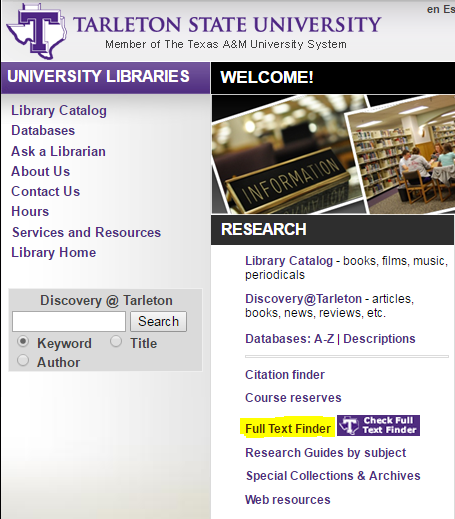
To use Full Text Finder first go to the library's webpage: http://www.tarleton.edu/library/. Then click on the Full Text Finder link highlighted in the screenshot below:
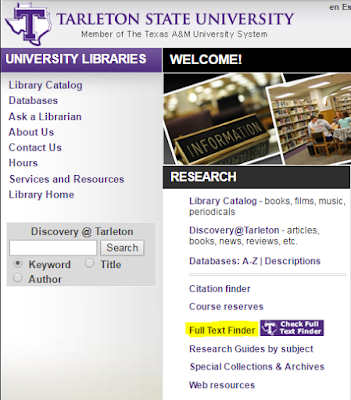
Full Text Finder link highlighted in yellow. 

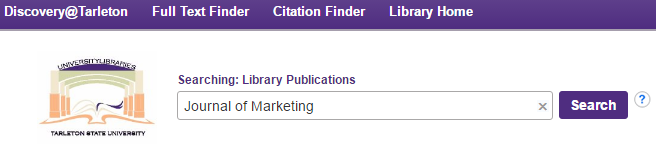
After you click the Full Text Finder link you will come to a search screen where you can type in the name of a particular periodical title (journal, magazine, newspaper). Below the search box there are links that allow you to browse for periodicals by title or by discipline.
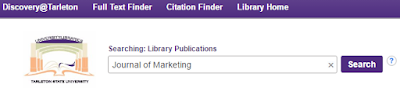
Searching for the Journal of Marketing
Your search results will let you know which databases have the periodical  you are looking for, and the date range of coverage provided in each database. There is also a search box, which allows you to search within that periodical.
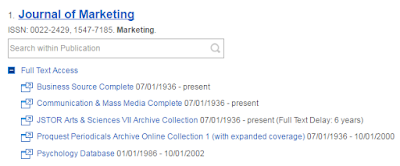
Search results. 

Citation Finder 

Another useful tool is Citation Finder. This is helpful when you are trying to track down a specific article. For example, you are reading a source and you want to find an article that is listed in that source's references.

Example citation.
After reading an article I found the citation above, and decided to use Citation Finder to see if this article was available through a Tarleton library database. To use Citation Finder first go to the library's website: http://www.tarleton.edu/library/. Then click on the Citation Finder link highlighted in the screenshot below.
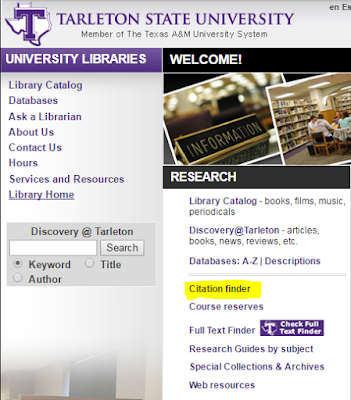
Citation Finder link highlighted in yellow.

After you click the Citation Finder link you will come to a search screen where you will need to input the article's bibliographic information. That information is found in the citation (see example above).

Input as much information as you can. If there is something you don't know, then leave it blank. The more information you provide, the more likely you will be linked to the correct source. At a minimum you should provide the journal title, article title, date, and author's last name. 
Fortunately, the article I'm looking for is available in the JSTOR database. Clicking on the link in the screenshot below took me directly to the article.

Link to full text of the article in the JSTOR database. 
If you need assistance using Full Text Finder or Citation Finder then contact the library at 254-968-1898 or reference@tarleton.edu.


Monday, January 23, 2017

Chinese New Year - January 28th

The biggest holiday of the year for Chinese families will soon be upon us: Chinese New Year (also known as Spring Festival) is happening this Saturday January 28th (New Year's Eve is the 27th). To compare the significance of this holiday for the American context, it would be like combining Christmas, Thanksgiving, and New Year's all in one. Click here to learn more about Chinese New Year. 

There are many different foods that are typically eaten on this occasion, and they are often symbolic of  increasing your chances of long life or wealth. One favorite is dumplings (like the ones pictured below), eating them on New Year's is supposed to bring increased wealth.
Dumplings (shui jiao 水餃) - Joshua Wallace, photographer and copyright holder, 2015.
Chinese New Year is based on a lunar calendar, and therefore doesn't happen on the same day every year on the solar calendar that we use. It fluctuates between mid-January to mid-February. According to the Chinese zodiac the new year will be the year of the chicken, and we are leaving the year of the monkey.  The Chinese zodiac consists of twelve animals, so the same animal reoccurs every twelve years. Click here to learn more about the Chinese zodiac. 


A common part of the Chinese New Year holiday is for the adults of the family to give red envelopes full of money to the children of the family. 
A Red Envelope (hong bao 紅包) - Joshua Wallace, photographer and copyright holder, 2017.
Roughly translated the words on the envelope mean "wish you prosperity, money is coming your way" (gong xi fa cai, gun gun er lai). 
A legend associated with the Chinese New Year is that of the Nian monster (nian shou 年獸). This creature comes out of hiding on New Year's Eve to eat people. Luckily, this monster is afraid of firecrackers and the color red, and that's why you see plenty of both this time of year. Typically, families will stay up late into the night to guard against the nian shou. According to some, this monster can eat a whole village in one bite. 

Some Chinese phrases for New Year's: 

  • Xin nian kuai le (新年快樂) - "Happy New Year"
  • Gong xi fa cai (恭禧發財) - A common expression heard during Chinese New Year, roughly translates to "Wishing you increased prosperity." A comical reply to this phrase is hong bao na lai (紅包拿來) which means "hand over the red envelope." 
If you want to learn Chinese or another language, then you should check out the Mango Languages database. It's available on the library website's A-Z database page. 

The library has several books about Chinese New Year in the Curriculum Collection, which is located on the lower level at our Stephenville location: 

Click here to listen to some Chinese New Year's music. That link takes you to the library's catalog, from there click on the "Online Access Click Here" link. 

Click here to watch a documentary about how modern Beijing families celebrate New Year's. 


International Programs will be hosting a Chinese New Year celebration on Friday January 27th from 6PM - 8PM at the Thompson Student Center. There will be food and activities. Click here for more details. 


Thursday, December 1, 2016

Mango: It’s More Than a Fruit


With winter break approaching you may be thinking about what to do with some free time. You could binge watch that series you have been meaning to watch or you could learn a foreign language.

One of the databases at the the library is Mango Languages. It is web based and there is an app so you can take it with you and it is free. In addition, you can use it anytime or place where you have an internet connection. Mango features 72 different languages including American Sign Language, Pirate, and Shakespeare English.

Several of the languages feature individual courses in conversation, travel, medical or business language skills. The lessons consist of a native speaker saying a phrase with the phrase written in the language. I did not notice an ability to learn how to read the language, but that may come by learning to recognize various words from the lesson.

До свидания