Thursday, March 31, 2016

Tarleton Thursdays: Edna Wolfe's Academic Record

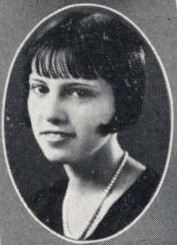
A couple months ago, we received some items belonging to 1925-26 Tarleton student Edna Myrtle Wolfe Blue (1906-2001, picture at right is from the 1926 Grassburr).  They were donated by her grandson Shawn Blue.  Shawn asked if there were any academic records available for his grandmother, and the Registar's office was able to locate them.  Shawn gave us permission to post the images in our library blog, saying, "Don't blank out the grades. She owned everything she ever did good or bad. A very transparent and honest person. She would challenge everybody who sees the post to do better than she did in her coursework."

The first page of the record gives basic information about Edna (and her father), and indicates the credits she earned in high school in Hico, Texas.  According to the April 15, 1925, Bulletin of the John Tarleton Agricultural College, page 36, a student needed 15 units of credits to be admitted to the Junior class.  Edna had 13, including the required two units in English and three in mathematics (two in algebra and one in plane geometery), so she was admitted to the Sophomore class--or at least, that's how it looks from this first page of her record.


However, apparently because Edna already had the required additional English credit to be placed in the Junior class, it appears from the second page of her record that she was allowed to take courses as a Junior. 


Below is an enlargement of the lower half of the page above (click on the photos to enlarge them further).  Note that Sp. 301 and Sp. 302 courses taken in the first and second semesters of the 1925-26 session have "H. S." written after them, and not any number for credits awarded.  My guess is that Edna took these courses to acquire the two additional credits she needed for Junior status.  These courses are described in the April 15, 1925, Bulletin (page 113) as "Beginners' Spanish for Juniors...Grammar; easy readings; simple themes; conversation.  Part of class work will be conducted in Spanish."


Finally, here is a further enlargement of Edna's first semester at Tarleton:


Besides the previously mentioned Spanish class, here are descriptions of the other courses she took, from the April 15, 1925, Bulletin:

Clo. 311 is the first semester of Clothing and Textiles (p. 98), which "embraces the same principles as that of clothing 301...but is designed especially to meet the needs of students who are high school graduates but who have done no credit work in clothing.  Clothing 301 (p. 97) "consists of principles of sewing and garment making, with a study of the history, production, manufacture, properties, and use of the textile fibers, with the hygiene and care of clothing.  The principles of dress design are studied and applied to problems."

Ed. 309 is the first semester of Methods of Teaching the Elementary School Subjects (p. 87), which "is required for the Elementary [teaching] Certificate.  Concrete demonstrations of the standard methods of teaching the elementary school subjects.  The laws of psychology, as applied to classroom instruction will be illustrated by the presentation of subject matter, lectures, readings, observations, and reports.  The organization of the subject matter in the lesson to show the more important from the lesser value.  Writing model lessons.  The proper methods of drill. The relation of the teacher to the pupils, principal, superintendent, parents, and the community."

E .301 is [English] Composition (p. 88).  "The aim of this course is to promote clearness and correctness of expression through practice in the simpler forms of composition.  Suitable types of literature will be studied."

Fo. 311 is Principles of Cooking and Nutrition (p. 99).  "This course embraces the study of foods as covered by 301...but is designed especially to meet the needs of those students who are graduates of a high school and have done no credit work in foods."  Food 301 (p. 98) covers "the fundamental principles and processes of cooking....It takes up food composition and nutritive values together with practice in food cookery.  In the latter part of the course instructions will be given in menu making and the problem of feeding the family."

Des. 301 is Design (p. 99). "This is a course in design for Home Economics students.  Line, dark and light, and color are taught.  Some of the processes are wool and silk embroidery, enamel work, sealing wax, tying and dyeing, stenciling, block printing, etc."

Mus. 311 is Music Appreciation (p. 94).  "This course is designed to meet the need of the Home Economics Department and all students who are seeking the cultural influence of music.  It will include lectures, theoretical study, round table discussions, outside preparation, parallel reading, and the art of listening and analysis.  Victrola records, recitals, and radio programs will be a strong feature of this course.... It is...a required subject in the Home Economics Department."

P.T. 301 is Physical Training [for women] (p. 117).  "This course consists of free-standing exercises, calisthenics, wands, Indian club and dumb-bell exercises (first series), and gymnastic games."

The five courses marked with an X enabled Edna to obtain a four-year elementary certificate, according to the section on page 29 of the April 15, 1925, Bulletin:


On the completion at Tarleton of five college courses of junior or senior rank a student may secure a four-year elementary certificate of the first class, provided one of these courses is in the department of English and one in the department of education, if...[it]...bears on elementary education.  This certificate is good for grades one to seven, inclusive, in any of the schools in the State.

Edna came back to Tarleton in the summers of 1928, 1929, and 1930, and took ten additional courses to earn her four-year high school teaching certificate.  According to page 34 of the February 15, 1928, Bulletin, 

...on the completion of ten college courses of junior or senior rank a student may secure a four-year high school certificate of the first class, provided one of these courses is in the department of  English and two are in the department of education, if one of the courses in education bears on high school subjects.  This certificate is good for any of the grades and for any of the high school subjects in any of the schools of the State.

Edna's record also indicates that transcripts were sent to NTSTC (North Texas State Teachers College, now the University of North Texas) in June 1942, and to the County Superintendent [of schools] in Hamilton, Texas, in October 1943.


Thursday, March 17, 2016

Take our Survey!

Win a prize!  

Tarleton students, please complete the survey at the link below to be eligible to win a portable Bluetooth speaker with LED lights (valued at $90). The Dick Smith Library staff are seeking feedback from users of the Library Learning Commons. The survey will only take a few minutes.  Include your email address and all completed surveys will be eligible to win the speaker.


Your feedback is important and survey results help us improve the Library Learning Commons and its services. Thank you.

https://tarleton.az1.qualtrics.com/SE/?SID=SV_6AamwHB11omVy5L

Thursday, March 3, 2016

Tarleton Thursday: Edna Wolfe's 1925 "Purple Book"

        On February 8, 2016, Shawn Blue of Waco kindly donated his grandmother's 1926 Grassburr, a leather book strap with a "Tarleton" buckle, and a 1925 "Purple Book." It was very fitting that he donated these precious items during Library Lovers Month. In last week's Tarleton Thursday blog post, Amanda discussed Edna Wolfe's (1906-2001) academic record, as it was an interest of her grandson. Today, we are going to take a look at the 55-page September 1, 1925 "Purple Book."

The"Purple Book" was established in 1917 as a student handbook and was in publication for 25 years. The book let students know what was expected of them while they were on Tarleton's campus: boys and girls dormitory regulations; academic regulations; and rules concerning discipline. 
 

Edna lived in the only girls dorm on campus called "The Dump." She and her roommates were called the "Dumplings" (JTAC 1925 Vol. 6, No. 4). Girls Dormitory Regulations were so important that in the back of Edna's "Purple Book" were two loose pages from another "Purple Book." These were the two pages on Girls Dormitory Regulations with a handwritten note at the top "To have and to hold." 


Of particular interest are the library regulations. Library rules/regulations can be found on page 13 through page 14. You'll notice that the first point made (44. a.) is that "the Library shall be open in accordance with a schedule approved by the Dean." In 1925, the library was "open from 7:40 a.m. until 6:00 p.m. every week day except Saturday, when it closes at 3:00 p.m. It was closed on Sundays and holidays" (1924-25 John Tarleton Agricultural College Catalogue, p. 23). I'd say being open until 2:00 a.m. is a huge difference from then to now. 

Another interesting rule is 44. e. In 1925, students could only check out "one book of fiction and one other book" for a two week period. Today, students can checkout 20 items at a time, most for 28 days. You'll notice that there is a "five cents per day fine for all books kept over time." Today, it's a mere ten cents per day fine for all items kept over time. To put that into perspective, five cents then would be the equivalent of 68 cents today. You could also purchase a bottle of Coca-Cola for five cents in 1925, as opposed to a $1 a can today.

At that time, the library was located in two rooms of the Administration Building and there was only one librarian. Today, we have a three floor building all to ourselves on the Stephenville campus, plus Texan Hall at the Fort Worth campus, and a total of 14 librarians. One of the most important rules then still applies today: YOU MUST PAY ALL FINES PROMPTLY IF YOU WISH TO MAINTAIN GOOD STANDING IN THE COLLEGE. 
  

Thursday, February 18, 2016

Maker Spot now open!

The Maker Spot is now open! It is located in room 250, on the Upper Level, next to the copy room. The new space gives the Tarleton community easy access to a wide range of equipment they can use for creation and innovation, regardless of their field of study.


It features: 
  • 3-D printing
  • 3-D scanning 
  • Large format/poster printing
  • GoPro action cameras and mounts
  • Computer board and Maker Kits
3-D printing costs $0.10 per gram and large format printing is $2 per square foot. All items check out for 7 days. You can submit your job and find out more information at our website, www.tarleton.edu/library/makerspot.html, or stop by the Maker Spot during our operating hours, Monday - Friday, 8am-5pm. You can also email Library Systems Department at libsys@tarleton.edu or call us at 254-968-0508. We hope to see you in the Maker Spot soon!

Tuesday, February 16, 2016

Library Lovers Bookmark Entries and Winner

February 1-10 the library held a bookmark contest in honor of Library Lovers Week.  
Alexis Brown was announced as the winner on Friday, February 12.

Alexis Brown and her bookmark entry.


Thanks to everyone who participated!!


Bookmark entries by: Alicia Cody, Nisha Aryal, Otoniel Chaine, Love Leigh Gonzales, Carrie Hale


Tuesday, February 9, 2016

Learn How to Read Online For Free!


To celebrate Library Lover’s Day, the library will host a Lessons @ Lunch highlighting OverDrive and EBSCO eBooks. Did you know that you have access to eBooks and audio-books? Why pay for books on your Kindle when you can borrow them for free? Overdrive is a borrowing service that is available to all Tarleton students, faculty and staff. A wide selection ranging from pleasure reading to academic titles can be accessed on many different devices. So come by the library Multipurpose Room on Thursday Feb. 11th from 12:15- 1 pm and learn how to set up your account. Bring your lunch with you and we will provide cookies and water. If you cannot join us on campus, you can view the presentation through Zoom.

Join from PC, Mac, Linux, iOS or Android: https://tarleton.zoom.us/j/554106421
Or join by phone:   +1 408 638 0968 (US Toll) or +1 646 558 8656 (US Toll)
    Meeting ID: 554 106 421
Or join from a H.323/SIP room system:    H.323: 162.255.37.11 (US West) or 162.255.36.11 (US East)
    Meeting ID: 554 106 421

 For more information, email mylibrary@tarleton.edu

Monday, February 8, 2016

Tarleton Student's Grandson Donates Items to Archives

It's Library Lovers Month here at Tarleton, and sometimes our library lovers aren't students, or faculty, or staff, or even alumni.  Today our library lover was the grandson of a Tarleton student, and he brought some of his grandmother's Tarleton items to donate to the archives.


Shawn Blue of Waco (pictured at left in the collage above) came by the Dick Smith Library today.  His grandmother, Edna Myrtle Wolfe (pictured upper right in the collage above), attended Tarleton for the 1925-1926 school year.  He donated her 1926 Grassburr yearbookher "Purple Book" student handbook dated September 1, 1925 (the subject for a future post), and a leather book strap with a "Tarleton" buckle (pictured lower right in the collage above).

Edna was born September 20, 1906, in Fairy, Texas, the oldest of five children of Hub Harvey and Altie M. Wolfe.  On the 1930 Census, Edna is living on the Hico Road in Hamilton County and working as a public school teacher - perhaps she was preparing for that career while at Tarleton.  She married William Clancy Blue, and their oldest son Dorsey Dwain Blue, born in 1937, was Shawn's father.  W. Clancy died in 2000 and Edna in 2001, and they are both buried in the Fairy Cemetery in Hamilton County.

Here's what Shawn had to say:

I really enjoyed my visit today. My grandmother held education in high regard and would be so pleased to know how delighted you were with her treasured Tarleton items. She did receive a two-year degree from Tarleton and was able to teach in public schools with it due a teacher shortage. She also taught at Pottsville. My dad Dorsey was their only child. Here is an interesting fact: my grandfather Clancy was one of Edna's students... That's how they met! 

Thank you, Shawn, for visiting us today, and for donating these items!

(photo of Shawn Blue by Collections Archivist Gary Spurr; photo of book strap by Archives and Reference Assistant Crystal Stanely; photo of Edna Wolfe from page 75 of the 1926 Grassburr at the Portal to Texas History.)

Thursday, February 4, 2016

Something I never thought about...


When we prepare for an interview we always think about how we will present ourselves. We submit a polished resume. We study all we can on the job that we want. We pay special attention to hygiene and dress. My daughter recently bought an entire new suit for a job interview. She really wanted the job!

But, until recently, I never really thought about how we speak -- our elocution. I'm from the south. Specifically I'm from Texas. Lived here all my life. I realize that I have a southern accent, but is it that bad? I guess it is. I remember meeting some out-of-towners (meaning out of state) many years ago, and they said, "I love the way you talk! It's adorable!" I really knew what they meant. They were politely saying that I sounded like a "hick from the sticks".

Do your speaking habits give the illusion that you are not as smart as you really are? I don't know. But, I do know the best way to present yourself to a potential boss is to put your best foot forward. One way to do that is to speak well. Read the following article, and you decide.


Sloppy speaking habits

Wednesday, February 3, 2016

Color Yourself Into Library Fame

Wanna be library famous? In honor of Library Lovers Day, we are conducting a bookmark coloring contest. The contest began Monday, February 1st, and will end February 10th. The winner will be announced Friday, February 12. Forms can be found at the Circulation Desk in the Dick Smith Library (Stephenville) and at the Service Desk in Texan Hall (Fort Worth). There's going to be some pretty amazing swag to be won. Not to mention someone will be immortalized on a bookmark that will be shared all over the library and campus!

Don't forget to help us celebrate Library Lovers Day with a limited edition button; they will be available next week. Grab one quick, they'll go fast! Also, tweet us @TarletonLib what you love about the library using #WeLoveTarletonLib.

Thursday, January 28, 2016

Ask a Librarian

Reference Department 2015
We've had a few comings and goings but we're still ready to assist you.
Stop by the Reference Desk for assistance!  
Have you ever had a library or research-related question when you were on the go or after the library's operating hours?
 
Did you know that the library has a service which allows you to ask your question at any time or any place?
 
The library's Reference Department provides email-based reference services where you can email reference@tarleton.edu and get a response within a 24 hour time-frame.
 
You can also visit the Ask a Librarian page to fill out a web form which will assist the librarian in answering your question.
 
Submit your question with as much detail as you can, and we'll work hard to find you the answer.
 
Have questions now?
 
We're just a click or a phone call away, (254)968-9249.


Thursday, January 14, 2016

What is a SMART Kapp Board

A SMART Kapp Board is similar to a white board but it connects with your phone.  First you download and open the SMART Kapp app or you can scan the QR code.  Your phone then connects to the board and anything you see on the board you see on your phone!  You can share in real-time with up to 5 users.  You can also save snapshots of the board to your phone.  When you are finished you can disconnect to end your session.


SMART Kapp Boards are located on the lower level of the library. 

Wednesday, January 13, 2016

New Year, New You

New Year's resolutions


Did you make any New Year's Resolutions this year? Are you still sticking to them? According to "Resolutions by the Numbers", about 45% of us make resolutions each year. However 73% will give up before the first goal is met.

So what can we do to meet our goals?
  1. Be realistic. Habits develop over time. Give yourself the needed time to attain the goal. Strive to lose 50 pounds in eight months instead of two months.
  2. Write it down. Keep a journal to see what your triggers are and to track your progress.
  3. Don't beat yourself up over a lapse. We all have moments of weakness. Don't let the midnight brownie derail you. Acknowledge that you're human and get yourself back on track.
  4. Ask for support. If your resolution is to get healther then you might start going to the gym 3 days a week with a friend. It'll help pass the time and make going fun instead of a chore.
  5. Be accountable. Tell your goals to family and friends who will help keep you on track. Another way to stay accountable would be to sign a commitment contract in StickK. If you do not meet the commitment then you are required to donate to a charity that you would not normally support.
For other goal setting tips:

http://www.apa.org/helpcenter/resolution.aspx

http://www.entrepreneur.com/article/243155

http://www.everydayhealth.com/denise-austin/10-tricks-for-setting-and-sticking-to-your-healthy-new-years-resolution.aspx#01

http://lifehacker.com/5971803/top-10-strategies-for-making-your-new-years-resolution-stick

Thursday, December 17, 2015

#NativismSyllabus - Guest post by Dr. Michael Landis, Assistant Professor of History

Introduction

On June 17, 2015, neo-Confederate white supremacist Dylan Roof entered the historic Emanuel African Methodist Church in Charleston, SC and murdered nine black parishioners.  The event, though sadly not unusual in the history of the United States, sparked immediate and profound national outrage.  In the aftermath, symbols of the Confederacy began to be removed and Americans struggled to come to grips with centuries of white supremacy terrorism.  A product of that struggle was the #CharlestonSyllabus (http://aaihs.org/resources/charlestonsyllabus/), compiled by the African American Intellectual History Society.  Scholars from around the world contributed to the list of the most important primary and secondary sources to understand what had happened in Charleston and what it meant for American society.

Since the summer of 2015, other issues have arisen to anger Americans and ignite impassioned debate, namely the role of newly-arrived immigrants in American society.  Syrians fleeing devastation and civil war in their home country; Central Americans yearning for jobs, security, and a better life – their arrival in the United States triggered alarm and fear among many Americans.  Politicians stoked the flames of hate, anger, and hostility, eager to ride this issue into high office.  Some politicos grabbed headlines by making wild accusations about foreign-born Americans and the dangers of the Islamic faith, suggesting national religious registries, internet censorship, and racial quotas.

Nativism – the fear of immigrants and the desire to deny them rights – has long been part of United States history.  Manifesting most famously (and effectively) in the Know Nothings of the 1850s, Chinese Exclusionists of the 1880s, the Ku Klux Klan of the 1920s, and Japanese Internment in the 1940s, nativism has proven a powerful force in American politics.  The books, essays, articles, and primary sources below provide a comprehensive road-map for understanding American nativism and immigration.

#NativismSyllabus was conceived and compiled by Dr. Michael Landis (@DrMichaelLandis), with the help of Margie Maxfield.  The hashtag started trending on December 8, 2015, in response to Republican presidential candidate Donald Trump's call to ban all Muslims from entering the United States.

Ms. Margie Maxfield, MSIS, is the Systems Librarian at Tarleton State University.

Dr. Michael Todd Landis is an Assistant Professor of History at Tarleton State University, board member of Historians Against Slavery (http://www.historiansagainstslavery.org/main/), and author of Northern Men with Southern Loyalties: The Democratic Party and the Sectional Crisis (http://www.cornellpress.cornell.edu/book/?GCOI=80140100250560&fa=author&person_id=5105).

Books:

Essays/ Articles:

Primary Sources: