Showing posts with label special collections. Show all posts

Thursday, September 21, 2017

Meet Our Staff: Phyllis Kinnison

Phyllis Kinnison
Librarian / Archivist
254-968-1808
pkinnison@tarleton.edu
Dick Smith Library – Lower Level, Room B05B


I came to Tarleton in September 2017 to serve as the new Librarian / Archivist. As an archivist it is my job to preserve the collective memory and culture of a community and its people. My job has three parts: (1) I collect materials of continuing usefulness such as diaries, letters, journals, ledgers, reports, etc.; (2) I arrange and preserve each collection; and (3) I describe each collection to help researchers find information. I think my job is very exciting, because I not only get to work with very old materials but also born-digital information stored on new formats such as CDs, DVDs, and hard drives.

I earned a BA in social studies education with a library science minor and a MA in history at The University of Louisiana at Monroe. I later earned my MLIS (master in library and information science) at Louisiana State University. In my career as an archivist, I’ve worked as a project archivist at Louisiana State University, in Baton Rouge, Louisiana; the head of special collections at Ouachita Baptist University, in Arkadelphia, Arkansas; and archivist at the Museum of South Texas History in McAllen, Texas. 

My father was in the Air Force the first 16 years of my life, so I have lived in many locations and enjoy traveling. The activities I enjoy include watching movies, reading, and gardening. My daughter, a freelance editor, lives in Austin with my three grandsons. My son lives in Nashville, where he works as the technical director of the Nashville Ballet.

Wednesday, August 3, 2016

Adventures in the Archives: Dr. Richard Lee Thompson

Adventures in the Archives continues....

Here's a little more information about Dr. Richard Lee Thompson, whose papers are part of the archives at the library, pulled together by Crystal Stanley, our former Archives and Reference Assistant (now the Director of Library Services at Ranger College):

Richard Lee Thompson was born in Stephenville on November 4, 1925.  He was the youngest son of Robert Lee Thompson and Corinne Barkley.  They had married in 1920 and purchased a home located at 343 North McIlhaney Street in Stephenville, on the east side of the present-day Tarleton State University campus.

A photo posted by Tarleton State University (@tarletonstate) on

The Thompson house had belonged to James Cox, who became President of John Tarleton College in 1913.  Cox had the house built in 1915, and lived and worked in the house until the Thompsons purchased it from him in 1920.  The original price for the house and surrounding acre of property was $4,800.  The house has a second front door because it was the door to Cox’s Presidential office.  Most of the house itself is still the original construction, minus three fireplaces, which were taken out in 1937 and replaced with a natural gas heating unit.
Richard’s parents are credited with providing John Tarleton College a soda shop, called Campus Corner. His mother Corinne operated the establishment for 20 years. However, the Campus Corner did not make enough profits to keep open, and it was closed.

Richard Thompson graduated from Stephenville High School in 1943.  That same year, he enlisted into the U.S. Navy on his eighteenth birthday.  Six weeks later, he was drafted.  He served as a medic with the Marine Corps for three and a half years, from 1944 until 1946.  He participated in the invasion of Okinawa, Japan, where he spent one year of his service.

Upon returning home, he enrolled in John Tarleton College.  He then attended Southern Methodist University, where he worked as a student instructor in Biology.  After graduating, Dr. Thompson was accepted into the Baylor University Dental School.

Dr. Thompson practiced for ten years at the State Hospital in San Antonio and was working in the VA Hospital in Chicago when his father Robert died in 1969. He returned to Erath County and took over the family real estate business. Over the years, the Thompson family acquired the full block of property adjacent to Tarleton on McIlhaney and at times had as many as 22 renters living in the houses once there.

Dr. Thompson's mother Corrine Barkley Thompson passed away in 1984.  Thompson continued to live in the family home.  In 1998, Dr. Thompson donated six land parcels on McIlhaney to the university for use as parking for nearby dorms. He also donated a 20-foot magnolia tree moved from one of his rental properties to a location near Davis Hall. When renovations on the Trogdon House (then called the Hall of Presidents) were completed and a request was made for donations of authentic period furnishings, Dr. Thompson contributed items with  unique historical ties the furniture has to the University.  The Tarleton Alumni Association named him a Distinguished Friend at Homecoming in October 2002.

Dr. Richard L. Thompson passed away on Saturday, June 5, 2004.  In his will, he created a trust fund of $100,000, where the interest alone would pay for the upkeep of his family home.  His will further stipulated that the house and all the furnishings remain as is.  The house currently functions as the Tarleton State University Alumni Association building.

A photo posted by Tarleton State University (@tarletonstate) on

Monday, August 1, 2016

Adventures in the Archives: Dr. Richard Thompson Collection - daguerrotypes and tintype

Adventures in the Archives continues....

When processing an archival collection, one may come across a rare find. In the case of the Dr. Richard L. Thompson D.D.S Papers, Crystal Stanley, our former Archives and Reference Assistant (now the Director of Library Services at Ranger College) found quite a few rarities. Six daguerreotypes and one tintype were discovered. You may be asking yourself: 


The first six images in this post are daugerrotypes.  They were on a silver-coated copper plate.  Daguerreotypes have a reflective surface, somewhat like a hologram. When viewed from one angle, a daguerreotype appears shiny and light-colored, and from the other angle it is negative with a duller matte finish.

Daguerreotypes are usually in a case sealed behind a thick piece of glass for protection, as the silver coat of the image is easy to damage.  The case often has a hinged cover, and the outside is sometimes covered with embossed leather, and lined with silk or velvet facing the picture.


Daguerrotypes were first used about 1839 and were popular until about 1860.

There is one tintype in the collection, which is pictured at left.  Tintypes, also known as ferrotypes, have grayish-white images with low contrast.  Tintypes were made on a thin black-enameled (or japanned) iron plate.  The process to make them was first developed about 1853.  Because then end product was lighter in weight, and because it was quicker and cheaper than the process to make daguerrotypes, tintypes had pretty much replaced the older process by 1860.  They remained popular in the early 1900s and even until about 1940.

Unfortunately, we have no idea who is pictured in this photographs.  All we can say for sure is that the daguerrotypes date after 1839 (and probably before 1860), and the tintype dates after 1853.   Likely these are images of ancestors of Dr. Richard L. Thompson, the owner.  More about him in the next post in this series.


For assistance with or to request to see archival materials, contact Collections Archivist Gary Spurr by phone at (254)968-1808, email at spurr@tarleton.edu or archives@tarleton.edu.


Monday, June 20, 2016

Adventures in the Archives: Robert "Bob" Glasgow Legislative Papers

Archival boxes housing materials from Glasgow Collection
Today, we are going to take an adventure through the archives and learn about Mr. Robert "Bob" Glasgow. He was born in 1942 and graduated from Stephenville H.S. After graduating high school, he served three years in the United States Army. He then went on to receive his Bachelor of Arts from Tarleton State College in 1967 where he served as class president and student body president. After his time at Tarleton, he went on to the University of Texas in Austin where he received his J.D. (Juris Doctor). In 1970, Glasgow started his own law practice in Stephenville, TX. He was named a Distinguished Alumnus at Tarleton State University in 1987. For eight years (1972-1980), Glasgow was the District Attorney for the 29th Judicial District that served Erath, Hood, and Palo Pinto counties. He was then nominated to the Texas Senate, serving the 22nd District of Texas from 1981 to 1993 (67th-72nd Legislature) as a Democrat. He has been a member of the Stephenville Chamber of Commerce since December 1979 and continues to serve Erath and the surrounding counties through his law firm and local affiliations.

Bound materials from Bob Glasgow Collection

The Bob Glasgow Texas Legislative Papers were donated to the Dick Smith Library by Glasgow circa 2008. The collection is housed in the Archives and is maintained by the Collections Archivist, Gary Spurr. Today, the collection is fully processed with a finding aid completed by Archives and Reference Assistant Crystal Stanley. The finding aid can be found on a web page that has been created to briefly describe the collection. The Bob Glasgow Texas Legislative Papers consists of bound copies of legislation, press clippings and releases, committee minutes, and redistricting minutes/information during the time Glasgow served on the Texas Legislature. Some materials originally housed in binders have been placed in folders and boxes. This collection is open for research, but advance notice is required before conducting research. 


For more information, contact the Collections Archivist Gary Spurr at spurr@tarleton.edu, (254)968-1808, or email archives@tarleton.edu

Check back in later this summer to learn more about collections in the archives.

Thursday, March 31, 2016

Tarleton Thursdays: Edna Wolfe's Academic Record

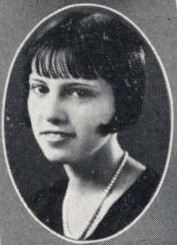
A couple months ago, we received some items belonging to 1925-26 Tarleton student Edna Myrtle Wolfe Blue (1906-2001, picture at right is from the 1926 Grassburr).  They were donated by her grandson Shawn Blue.  Shawn asked if there were any academic records available for his grandmother, and the Registar's office was able to locate them.  Shawn gave us permission to post the images in our library blog, saying, "Don't blank out the grades. She owned everything she ever did good or bad. A very transparent and honest person. She would challenge everybody who sees the post to do better than she did in her coursework."

The first page of the record gives basic information about Edna (and her father), and indicates the credits she earned in high school in Hico, Texas.  According to the April 15, 1925, Bulletin of the John Tarleton Agricultural College, page 36, a student needed 15 units of credits to be admitted to the Junior class.  Edna had 13, including the required two units in English and three in mathematics (two in algebra and one in plane geometery), so she was admitted to the Sophomore class--or at least, that's how it looks from this first page of her record.


However, apparently because Edna already had the required additional English credit to be placed in the Junior class, it appears from the second page of her record that she was allowed to take courses as a Junior. 


Below is an enlargement of the lower half of the page above (click on the photos to enlarge them further).  Note that Sp. 301 and Sp. 302 courses taken in the first and second semesters of the 1925-26 session have "H. S." written after them, and not any number for credits awarded.  My guess is that Edna took these courses to acquire the two additional credits she needed for Junior status.  These courses are described in the April 15, 1925, Bulletin (page 113) as "Beginners' Spanish for Juniors...Grammar; easy readings; simple themes; conversation.  Part of class work will be conducted in Spanish."


Finally, here is a further enlargement of Edna's first semester at Tarleton:


Besides the previously mentioned Spanish class, here are descriptions of the other courses she took, from the April 15, 1925, Bulletin:

Clo. 311 is the first semester of Clothing and Textiles (p. 98), which "embraces the same principles as that of clothing 301...but is designed especially to meet the needs of students who are high school graduates but who have done no credit work in clothing.  Clothing 301 (p. 97) "consists of principles of sewing and garment making, with a study of the history, production, manufacture, properties, and use of the textile fibers, with the hygiene and care of clothing.  The principles of dress design are studied and applied to problems."

Ed. 309 is the first semester of Methods of Teaching the Elementary School Subjects (p. 87), which "is required for the Elementary [teaching] Certificate.  Concrete demonstrations of the standard methods of teaching the elementary school subjects.  The laws of psychology, as applied to classroom instruction will be illustrated by the presentation of subject matter, lectures, readings, observations, and reports.  The organization of the subject matter in the lesson to show the more important from the lesser value.  Writing model lessons.  The proper methods of drill. The relation of the teacher to the pupils, principal, superintendent, parents, and the community."

E .301 is [English] Composition (p. 88).  "The aim of this course is to promote clearness and correctness of expression through practice in the simpler forms of composition.  Suitable types of literature will be studied."

Fo. 311 is Principles of Cooking and Nutrition (p. 99).  "This course embraces the study of foods as covered by 301...but is designed especially to meet the needs of those students who are graduates of a high school and have done no credit work in foods."  Food 301 (p. 98) covers "the fundamental principles and processes of cooking....It takes up food composition and nutritive values together with practice in food cookery.  In the latter part of the course instructions will be given in menu making and the problem of feeding the family."

Des. 301 is Design (p. 99). "This is a course in design for Home Economics students.  Line, dark and light, and color are taught.  Some of the processes are wool and silk embroidery, enamel work, sealing wax, tying and dyeing, stenciling, block printing, etc."

Mus. 311 is Music Appreciation (p. 94).  "This course is designed to meet the need of the Home Economics Department and all students who are seeking the cultural influence of music.  It will include lectures, theoretical study, round table discussions, outside preparation, parallel reading, and the art of listening and analysis.  Victrola records, recitals, and radio programs will be a strong feature of this course.... It is...a required subject in the Home Economics Department."

P.T. 301 is Physical Training [for women] (p. 117).  "This course consists of free-standing exercises, calisthenics, wands, Indian club and dumb-bell exercises (first series), and gymnastic games."

The five courses marked with an X enabled Edna to obtain a four-year elementary certificate, according to the section on page 29 of the April 15, 1925, Bulletin:


On the completion at Tarleton of five college courses of junior or senior rank a student may secure a four-year elementary certificate of the first class, provided one of these courses is in the department of English and one in the department of education, if...[it]...bears on elementary education.  This certificate is good for grades one to seven, inclusive, in any of the schools in the State.

Edna came back to Tarleton in the summers of 1928, 1929, and 1930, and took ten additional courses to earn her four-year high school teaching certificate.  According to page 34 of the February 15, 1928, Bulletin, 

...on the completion of ten college courses of junior or senior rank a student may secure a four-year high school certificate of the first class, provided one of these courses is in the department of  English and two are in the department of education, if one of the courses in education bears on high school subjects.  This certificate is good for any of the grades and for any of the high school subjects in any of the schools of the State.

Edna's record also indicates that transcripts were sent to NTSTC (North Texas State Teachers College, now the University of North Texas) in June 1942, and to the County Superintendent [of schools] in Hamilton, Texas, in October 1943.


Thursday, March 3, 2016

Tarleton Thursday: Edna Wolfe's 1925 "Purple Book"

        On February 8, 2016, Shawn Blue of Waco kindly donated his grandmother's 1926 Grassburr, a leather book strap with a "Tarleton" buckle, and a 1925 "Purple Book." It was very fitting that he donated these precious items during Library Lovers Month. In last week's Tarleton Thursday blog post, Amanda discussed Edna Wolfe's (1906-2001) academic record, as it was an interest of her grandson. Today, we are going to take a look at the 55-page September 1, 1925 "Purple Book."

The"Purple Book" was established in 1917 as a student handbook and was in publication for 25 years. The book let students know what was expected of them while they were on Tarleton's campus: boys and girls dormitory regulations; academic regulations; and rules concerning discipline. 
 

Edna lived in the only girls dorm on campus called "The Dump." She and her roommates were called the "Dumplings" (JTAC 1925 Vol. 6, No. 4). Girls Dormitory Regulations were so important that in the back of Edna's "Purple Book" were two loose pages from another "Purple Book." These were the two pages on Girls Dormitory Regulations with a handwritten note at the top "To have and to hold." 


Of particular interest are the library regulations. Library rules/regulations can be found on page 13 through page 14. You'll notice that the first point made (44. a.) is that "the Library shall be open in accordance with a schedule approved by the Dean." In 1925, the library was "open from 7:40 a.m. until 6:00 p.m. every week day except Saturday, when it closes at 3:00 p.m. It was closed on Sundays and holidays" (1924-25 John Tarleton Agricultural College Catalogue, p. 23). I'd say being open until 2:00 a.m. is a huge difference from then to now. 

Another interesting rule is 44. e. In 1925, students could only check out "one book of fiction and one other book" for a two week period. Today, students can checkout 20 items at a time, most for 28 days. You'll notice that there is a "five cents per day fine for all books kept over time." Today, it's a mere ten cents per day fine for all items kept over time. To put that into perspective, five cents then would be the equivalent of 68 cents today. You could also purchase a bottle of Coca-Cola for five cents in 1925, as opposed to a $1 a can today.

At that time, the library was located in two rooms of the Administration Building and there was only one librarian. Today, we have a three floor building all to ourselves on the Stephenville campus, plus Texan Hall at the Fort Worth campus, and a total of 14 librarians. One of the most important rules then still applies today: YOU MUST PAY ALL FINES PROMPTLY IF YOU WISH TO MAINTAIN GOOD STANDING IN THE COLLEGE. 
  

Monday, February 8, 2016

Tarleton Student's Grandson Donates Items to Archives

It's Library Lovers Month here at Tarleton, and sometimes our library lovers aren't students, or faculty, or staff, or even alumni.  Today our library lover was the grandson of a Tarleton student, and he brought some of his grandmother's Tarleton items to donate to the archives.


Shawn Blue of Waco (pictured at left in the collage above) came by the Dick Smith Library today.  His grandmother, Edna Myrtle Wolfe (pictured upper right in the collage above), attended Tarleton for the 1925-1926 school year.  He donated her 1926 Grassburr yearbookher "Purple Book" student handbook dated September 1, 1925 (the subject for a future post), and a leather book strap with a "Tarleton" buckle (pictured lower right in the collage above).

Edna was born September 20, 1906, in Fairy, Texas, the oldest of five children of Hub Harvey and Altie M. Wolfe.  On the 1930 Census, Edna is living on the Hico Road in Hamilton County and working as a public school teacher - perhaps she was preparing for that career while at Tarleton.  She married William Clancy Blue, and their oldest son Dorsey Dwain Blue, born in 1937, was Shawn's father.  W. Clancy died in 2000 and Edna in 2001, and they are both buried in the Fairy Cemetery in Hamilton County.

Here's what Shawn had to say:

I really enjoyed my visit today. My grandmother held education in high regard and would be so pleased to know how delighted you were with her treasured Tarleton items. She did receive a two-year degree from Tarleton and was able to teach in public schools with it due a teacher shortage. She also taught at Pottsville. My dad Dorsey was their only child. Here is an interesting fact: my grandfather Clancy was one of Edna's students... That's how they met! 

Thank you, Shawn, for visiting us today, and for donating these items!

(photo of Shawn Blue by Collections Archivist Gary Spurr; photo of book strap by Archives and Reference Assistant Crystal Stanely; photo of Edna Wolfe from page 75 of the 1926 Grassburr at the Portal to Texas History.)

Thursday, October 15, 2015

It's #ArchivesMonth

October is #ArchivesMonth. What does that mean? #ArchivesMonth is a chance for archivists to educate the public on what an archive is, what archives are, and what archivists do. We will be sending out tweets all month highlighting the Tarleton Archives. Please view the video below to see a brief overview of some items the Library's Special Collections & Archives have and services we offer.


If you're not certain what an archive is or what archives are, check out this article titled "What is an Archives?". Feel free to contact any of the Special Collections & Archives staff if you have any questions.

Amanda Pape, Coordinator for Archives and Special Services, pape@tarleton.edu, (254)968-9251
Gary Spurr, Collections Archivist, spurr@tarleton.edu, (254)968-1808
Crystal Stanley, Archives & Reference Assistant, cstanley@tarleton.edu, (254)968-9496

On October 27th from 12:10pm-12:50pm in the Library's Multipurpose Room, the Library will be hosting a Brown Bag presentation on "How to preserve your family records" by Gary Spurr. Please feel free to bring your lunch! We hope to see you there. 


Don't forget to follow us on Twitter @tarletonlib to see all of the wonderful tweets about #ArchivesMonth. 


Tuesday, January 29, 2013

Limited and Local History Collections


One of the many services the library has to offer is found in our Limited and Local History Collections. Here are the many services we have to offer our patrons:
  • Tarleton State University archives
  • Tarleton State University theses and dissertations submitted for degrees
  • Tarleton State University Grassburr yearbooks
  • Displays of Tarleton State University artifacts
  • Drs. Marie and Nathan Cedars Holocaust collection
  • Edward Lear, Lewis Carroll, and William Morris collections donated by Dr. Joe R. Christopher
  • Michael Moser collection
  • Col. and Mrs. Milton P. Brooks bound volumes of The National Geographic
  • Dr. C. Richard King books and materials
  • Dr. Dick Smith books and materials
  • Local history and genealogy collections
  • Stephenville Empire-Tribune since 1882 on microfilm (some gaps)
  • Microfilm records for Erath, Brown, Callahan, Shackleford and Stephens counties

As I was preparing for something to write for our LOL blog I started thinking about some of the services we provided and I went to The J-TAC (Tarleton State University Student Newspaper) online. I was curious to see if I searched for my name and the years that I was a student at Tarleton if anything would come up. I was surprised (and a little excited) to see my maiden name come up in several issues.

So, if you or someone you know was a student, faculty or staff member at Tarleton go and check out the
The J-TAC (Tarleton State University Student Newspaper). You just might be surprised to find some interesting information!


Wednesday, March 25, 2009

Fore-Edge Paintings

In a recent post here, Janie mentioned fore-edge paintings, something I’ve wanted to blog about for a long time! It's easier to show how fore-edge paintings work than write/talk about them, so I've included some very-short videos (with no audio) below.

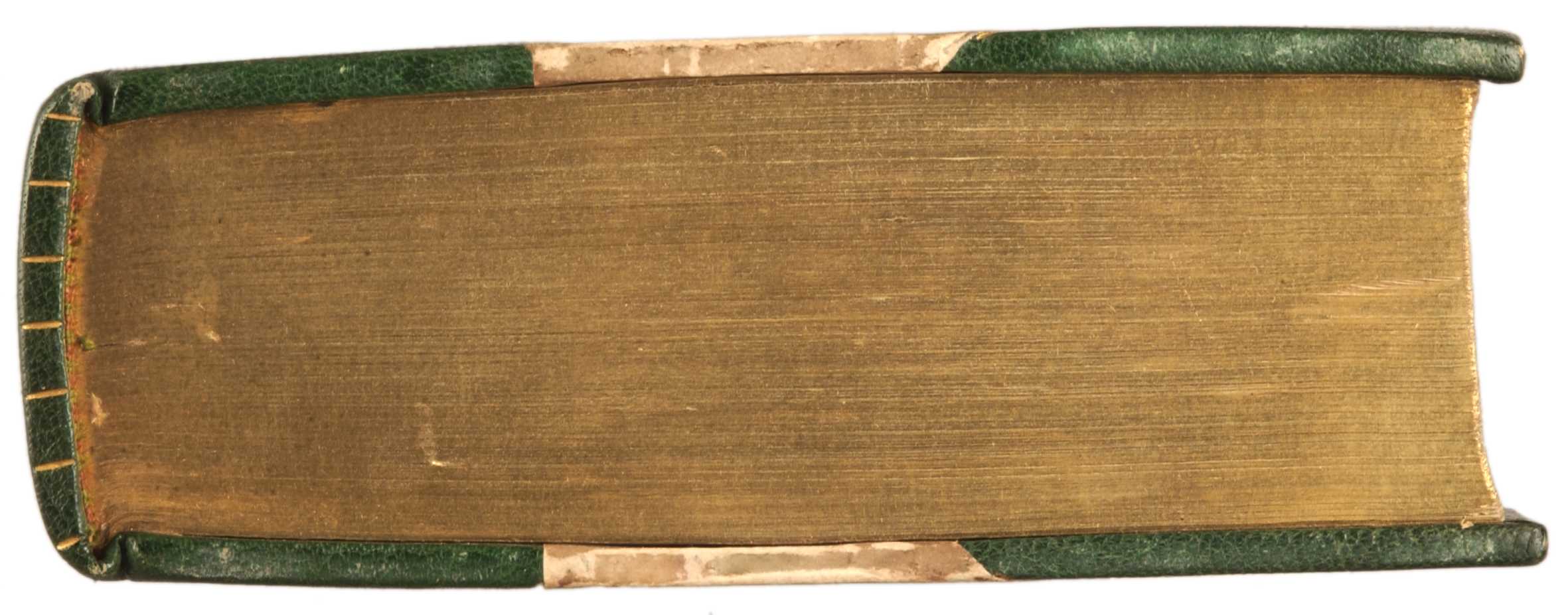
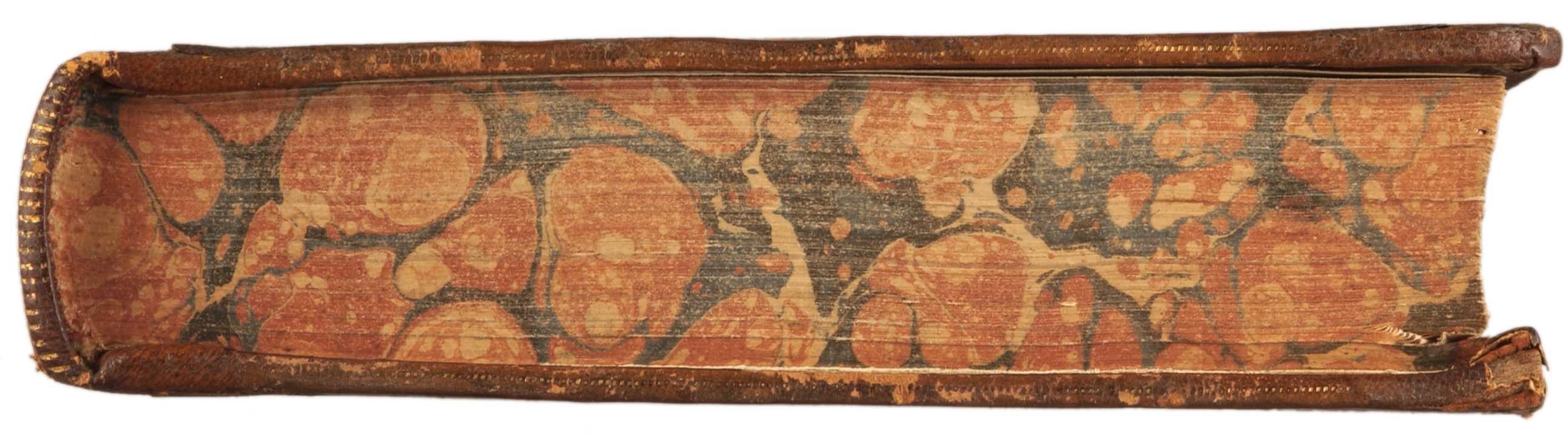
If you are holding a book in your hand, then the fore-edge is the long edge of the pages that you can turn or fan out. Fore-edge painting refers to any painted decoration of this fore-edge. Some are visible when the book is closed, but most are only visible when the pages are slightly fanned. The painting is further hidden when the book is closed by applying gilt (gold-leaf) or marbling to the edge. The most common type is a single fore-edged painting:

There are also split and panoramic fore-edge paintings. Split fore-edge paintings can be done on thick books, where each half of the book’s fore-edge has a different illustration (here’s an example). Panoramic fore-edge paintings occur not only on the book’s main fore-edge, but on the fanned-out top and/or bottom edges of the book as well, giving a near-270-degree panoramic view:

The most rare type are double fore-edge paintings, which show one image when the fore-edge is fanned out the usual way, and a completely different picture when the pages are fanned out in the opposite direction:

There are even triple fore-edge paintings, where the edge is not gilded or marbled and instead has an illustration visible when the book is closed. As far as I know, there are no fore-edge paintings on any books in the Dick Smith Library. However, I will be checking books with gilt or marbled edges in our Special Collections just to make sure!

Fore-edge paintings date back to the 10th century and were a popular art form in the 18th and 19th centuries. The detail on these miniature paintings is incredible! There are some great examples in the Boston Public Library Flickr set. For more information, check out these Delicious links.

Friday, March 6, 2009

Libraries' Surprising Special Collections

"Tucked away in libraries across the country are unexpected archives and world-class treasures" according to the Smithsonian.

Although the article is interesting, Jessamyn West made it much more useful by providing links to these collections (where available) at Unburied. The comments lead the reader to even more special collections across the country! I like stbalbach's observation that "Special collections are often the end result of one persons lifetime magnificent obsession."

And I learned that there is actually a name for all those pictures we draw on the page edges of our textbooks: fore-edge paintings! Wow! There is a name for everything! Tarleton, too, has special collections, which were noted in a previous blog. They are housed in a special section (of course) of the library. Visit us!